



Welcome to Sports Politika, a media venture founded by investigative journalist and researcher Karim Zidan that strives to help you understand how sports and politics shape the world around us. My mission is to offer an independent platform for accessible journalism that raises awareness and empowers understanding.
If you share this vision, please consider supporting my work by joining becoming a paid subscriber. We are currently offering 60% off annual subscriptions to celebrate Sports Politika’s third anniversary. Don’t miss out!
The 1970 FIFA World Cup in Mexico arrived at a moment when Brazil was living two parallel realities.
On one side stood the most luminous national football team the world had ever seen: a Seleção whose fluid, joyous style felt like an expression of freedom itself. On the other stood a military dictatorship that had seized power in 1964 and, by the end of the decade, hardened into one of the most repressive regimes in Latin America. Football became the bridge between those realities.
General Emílio Garrastazu Médici, who assumed the presidency in 1969, understood that football was Brazil’s closest equivalent to a secular faith, capable of commanding loyalty that politics alone could not. That belief shaped his courtship of Pelé and his approach to the 1970 World Cup. Brazil’s eventual victory proved that football could polish authoritarian power.
By the time the 1978 World Cup began, Argentina was deep into the Dirty War. The military junta led by General Jorge Rafael Videla had seized power in 1976 and unleashed a campaign of systematic terror. Tens of thousands were abducted into a network of detention centers where torture and execution were routine. Yet Argentina had been awarded the World Cup long before the coup, and the generals quickly recognized its value. Football was declared a matter of “national interest,” and the regime worked relentlessly to present Argentina as stable, modern, and united.
Episode 1: The Fascist World Cup

Welcome to Sports Politika, a media venture founded by investigative journalist and researcher Karim Zidan that strives to help you understand how sports and politics shape the world around us. My mission is to offer an independent platform for accessible journalism that raises awareness and empowers understanding.
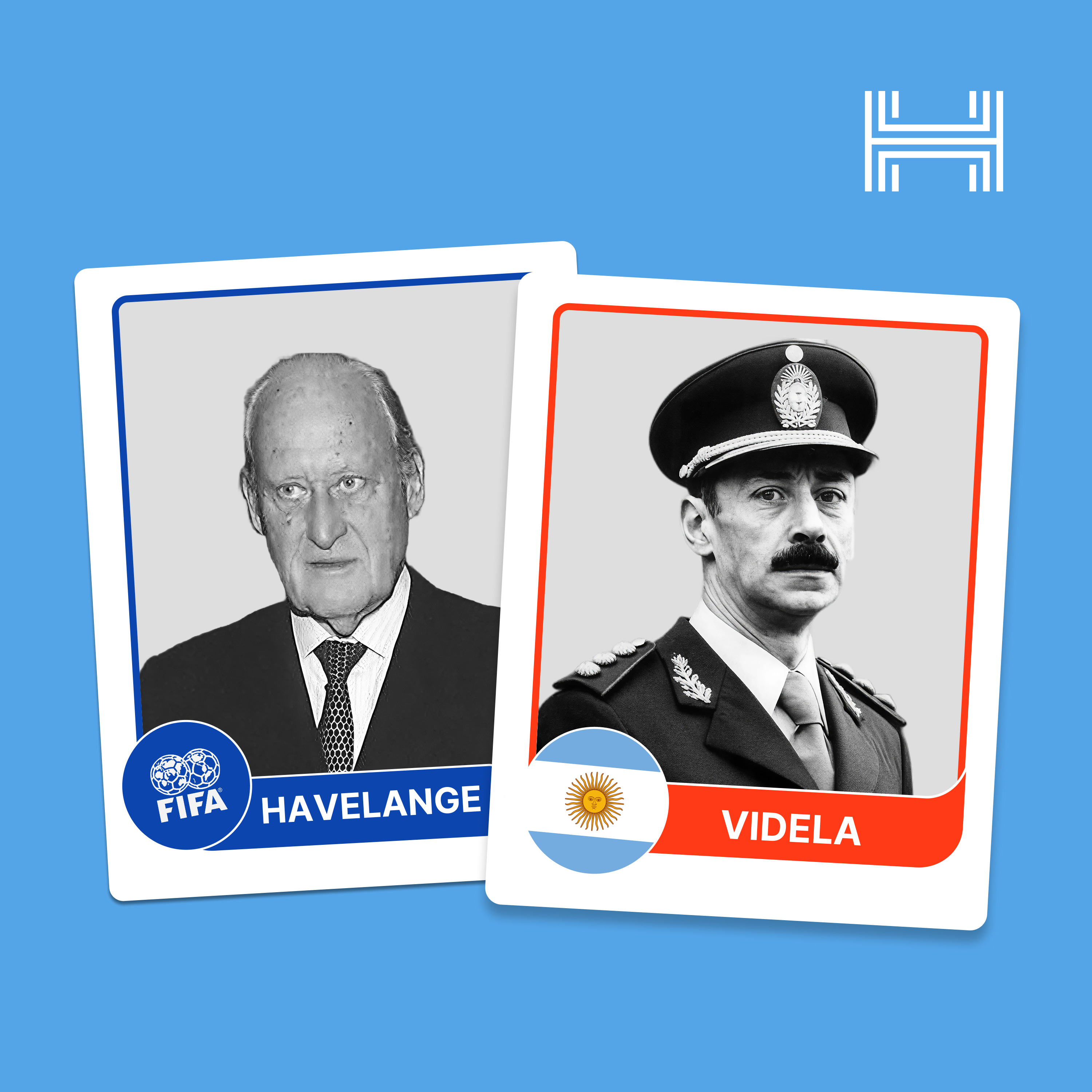
When Argentina won the final against the Netherlands, the image that lingered was not just Daniel Passarella lifting the trophy, but Videla standing beside him. FIFA president João Havelange handed the cup to the dictator, who then passed it to his players—a symbolic chain that emphasized FIFA’s role in propping up these military regimes.
Since being elected FIFA President in 1974, Havelange set about changing FIFA’s internal culture. Instead of following the ethos of Jules Rimet, who prized the dignity of sport, Havelange—the son of an arms dealer—was far more transactional. He prized loyalty, discretion, and deal-making over transparency. In that environment, authoritarian regimes made for excellent bedfellows.
In those years, football crossed a threshold. It remained a game capable of beauty and transcendence, but it also became a tool of statecraft, propaganda, and institutional power. The cheers were real. The goals were real. But so was the silence that surrounded them—and the structures that learned how to use it.
Listen to Episode 2 of Power Plays to learn more about this pivotal time in FIFA history.
Episode 1: The Fascist World Cup
Welcome to Sports Politika, a media venture founded by investigative journalist and researcher Karim Zidan that strives to help you understand how sports and politics shape the world around us. My mission is to offer an independent platform for accessible journalism that raises awareness and empowers understanding.
Sports Politika is a media platform dedicated to the intersection of sports, power and politics. If you like what you see, upgrade to a paid subscription (or gift a subscription if you already have your own). We would appreciate if you could also like the post and let us know what you think in the comment section below.


