



Welcome to Sports Politika, a media venture founded by investigative journalist and researcher Karim Zidan that strives to help you understand how sports and politics shape the world around us. My mission is to offer an independent platform for accessible journalism that raises awareness and empowers understanding.
If you share this vision, please consider supporting my work by joining becoming a paid subscriber.
On December 2, 2010, inside FIFA headquarters in Zurich, the organization’s executive committee voted to award the 2018 FIFA World Cup to Russia and the 2022 tournament to Qatar.
It was the first time the World Cup would be staged in Eastern Europe and in the Arab Gulf. It was also the first time that the world’s most prestigious mega-event would be held in back-to-back authoritarian states, altering the trajectory of world football for a generation.
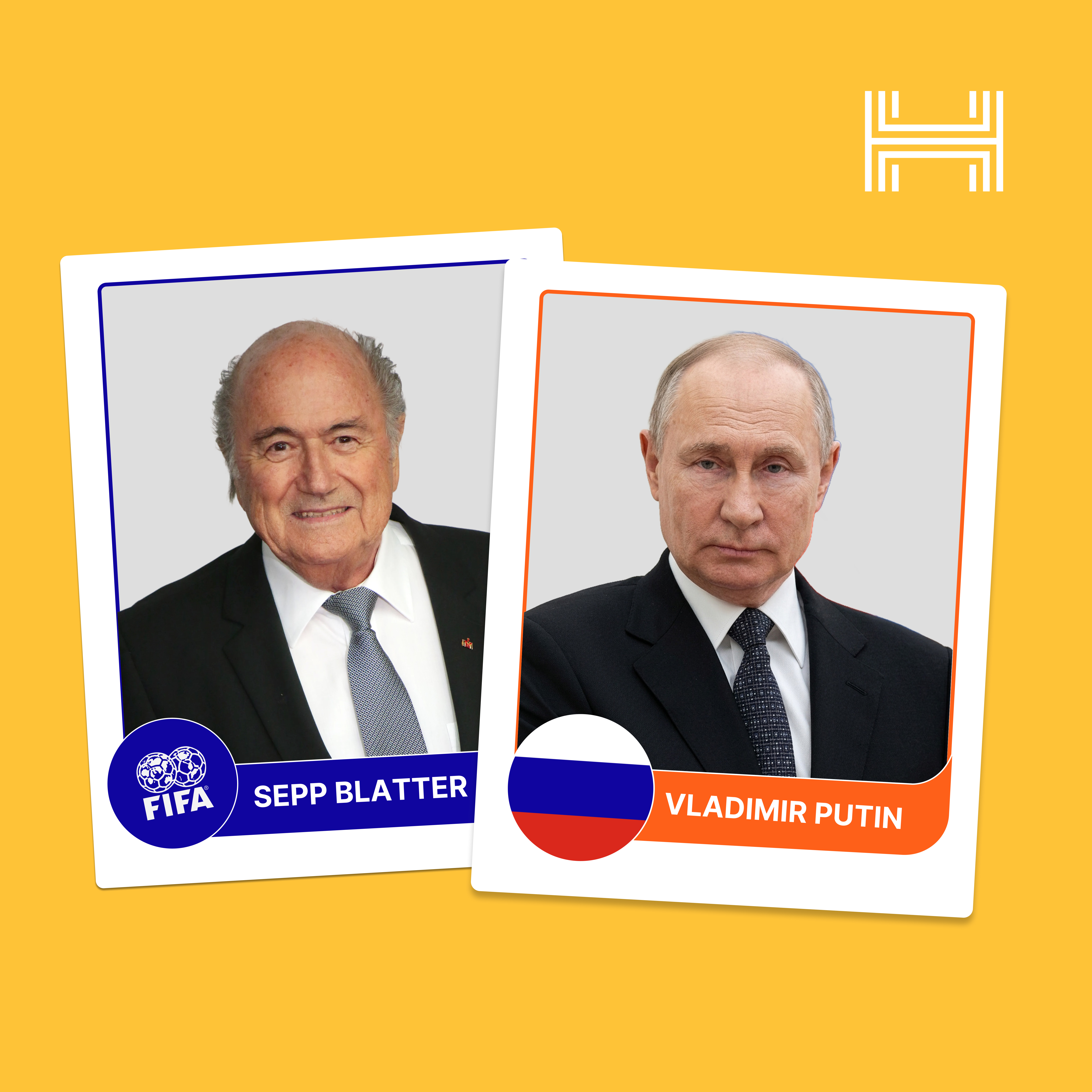
To understand how Russia secured the World Cup, one must first understand the system that made it possible, including the man at the organization’s helm: Sepp Blatter.
Born in Visp, Switzerland in 1936, Blatter joined FIFA in 1975 after a varied career that included roles as head of public relations for the tourist board of Visp, as well as general secretary of the Swiss Ice Hockey Federation. He became FIFA president in 1998, succeeding Havelange after spending 17 years as FIFA’s general secretary.
Following in Havelange’s footsteps, Blatter consolidated authority within an organization already criticized for patronage politics. He expanded development funding to smaller federations, building loyalty across Africa, Asia, and the Caribbean.
But the same centralized power that fuelled FIFA’s growth also cultivated corruption. By the early 2000s, accusations of bribery and vote-buying were common. The 2010 vote awarding the World Cups to Russia and Qatar became a flashpoint. Critics pointed to Russia’s limited infrastructure at the time, concerns about governance and human rights, and the scale of investment required.
In 2015, just three years before Russia’s tournament, U.S. authorities unsealed sweeping indictments against FIFA officials in a corruption probe. Several executives were arrested in Zurich. Although Blatter initially survived, he resigned soon after amid mounting pressure and was later banned from football for ethics violations.
By the time Russia hosted in 2018, the man who had presided over its selection was gone but the political architecture he built remained intact, ready to be manipulated by one of the world’s most cunning and ruthless autocrats.
Sport, too, became central to Putin’s vision for a post-Soviet Russia. Mega-events like the 2014 Winter Olympics in Sochi offered an unprecedented platform to celebrate Putin’s Russia—an enormous showcase of infrastructure and spectacle. It worked, with the world celebrating Russia’s return to the liberal order.
Four days after the closing ceremony for the 2014 Winter Games, Russian soldiers began their military operation to annex Crimea, then international recognized as part of Ukraine.
The annexation of Crimea put an end to much of the goodwill that Russia had received from hosting the Winter Games. Western sanctions crippled its economy; diplomatic expulsions followed as Russia faced strained relations with much of Europe and the United States.
It was precisely in this climate of Cold-War esque geopolitical tension that Russia began preparing to host the 2018 World Cup.
Russia committed roughly $11–12 billion to stadium construction, transportation upgrades, and urban development across 11 host cities, from Kaliningrad on the Baltic to Yekaterinburg near the Urals. New stadiums rose in Moscow, St. Petersburg, and beyond. Airports were renovated. High-speed rail lines improved connections.
Russian authorities sought to counter narratives of isolation and authoritarianism by presenting a welcoming, efficient, culturally vibrant nation. State media emphasized hospitality. Visa-free Fan IDs simplified travel. Volunteers were trained to greet foreigners warmly.
But skepticism remained. International outlets questioned Russia’s human rights record, its anti-LGBTQ+ legislation, and the threat posed by organized hooligan groups. Several Russian host cities faced international criticism over reports that authorities were killing stray dogs in an effort to present a cleaner image to visiting fans.
Russia also moved to rein in one of its most notorious subcultures: organized football hooliganism. Russian fan groups had drawn international scrutiny after violent clashes with England supporters at Euro 2016 in Marseille, fueling concerns that similar disorder could erupt on home soil. Determined to avoid embarrassment during a tournament meant to showcase a modern, controlled Russia, Vladimir Putin’s government adopted a far tougher stance. Authorities expanded surveillance, imposed travel bans on known troublemakers, strengthened stadium security laws, and worked closely with security services to monitor extremist fan networks.
The crackdown reflected a broader pattern in Putin’s governance—permitting displays of aggressive patriotism when useful, but swiftly suppressing them when they threatened state control or international prestige.
The World Cup had thus become an exercise in soft power.
Listen to Episode 3 of Power Plays on your favourite podcast platform now.
Episode 1: The Fascist World Cup

Welcome to Sports Politika, a media venture founded by investigative journalist and researcher Karim Zidan that strives to help you understand how sports and politics shape the world around us. My mission is to offer an independent platform for accessible journalism that raises awareness and empowers understanding.
Episode 2: Pelé, the Dirty Wars, and the Monster in the Streets

Welcome to Sports Politika, a media venture founded by investigative journalist and researcher Karim Zidan that strives to help you understand how sports and politics shape the world around us. My mission is to offer an independent platform for accessible journalism that raises awareness and empowers understanding.
Sports Politika is a media platform dedicated to the intersection of sports, power and politics. If you like what you see, upgrade to a paid subscription (or gift a subscription if you already have your own). We would appreciate if you could also like the post and let us know what you think in the comment section below.


