




Welcome to Sports Politika, a media venture founded by investigative journalist and researcher Karim Zidan that strives to help you understand how sports and politics shape the world around us. My mission is to offer an independent platform for accessible journalism that raises awareness and empowers understanding.
If you share this vision, please consider supporting my work by joining becoming a paid subscriber. We are currently offering 60% off annual subscriptions to celebrate Sports Politika’s third anniversary. Don’t miss out!
At the turn of the twentieth century, football was still a young, malleable thing.
Its rules had only recently been standardized in Britain, and even then they varied from place to place. The game was slower and more physical. There were no substitutes, muddy pitches were the norm, and tactics were childishly simple by modern standards. Footballers were often workers first and athletes second—dockhands, factory laborers, clerks—playing for civic pride.
The world that surrounded the game was also changing. Industrialization had torn people from villages and traditions, pushing them into dense cities where older forms of community, such as the church, were weakening. Empires were crumbling The First World War was looming, eager to demonstrate that modernity could annihilate millions with exceptional efficiency. In this environment, football became more than a pastime. It offered rhythm in a chaotic age, a shared calendar of matches and rivalries, and a collective emotional escape.
By the 1920s, football had become a language that crossed class and literacy barriers. For nations newly formed or newly traumatized by war, football offered a way to imagine themselves as coherent, disciplined, and worthy. International football, too, was still in its adolescence. Founded in 1904, the Fédération Internationale de Football Association (FIFA) was a fragile and largely administrative body that lacked both the authority and the financial independence it would later acquire.
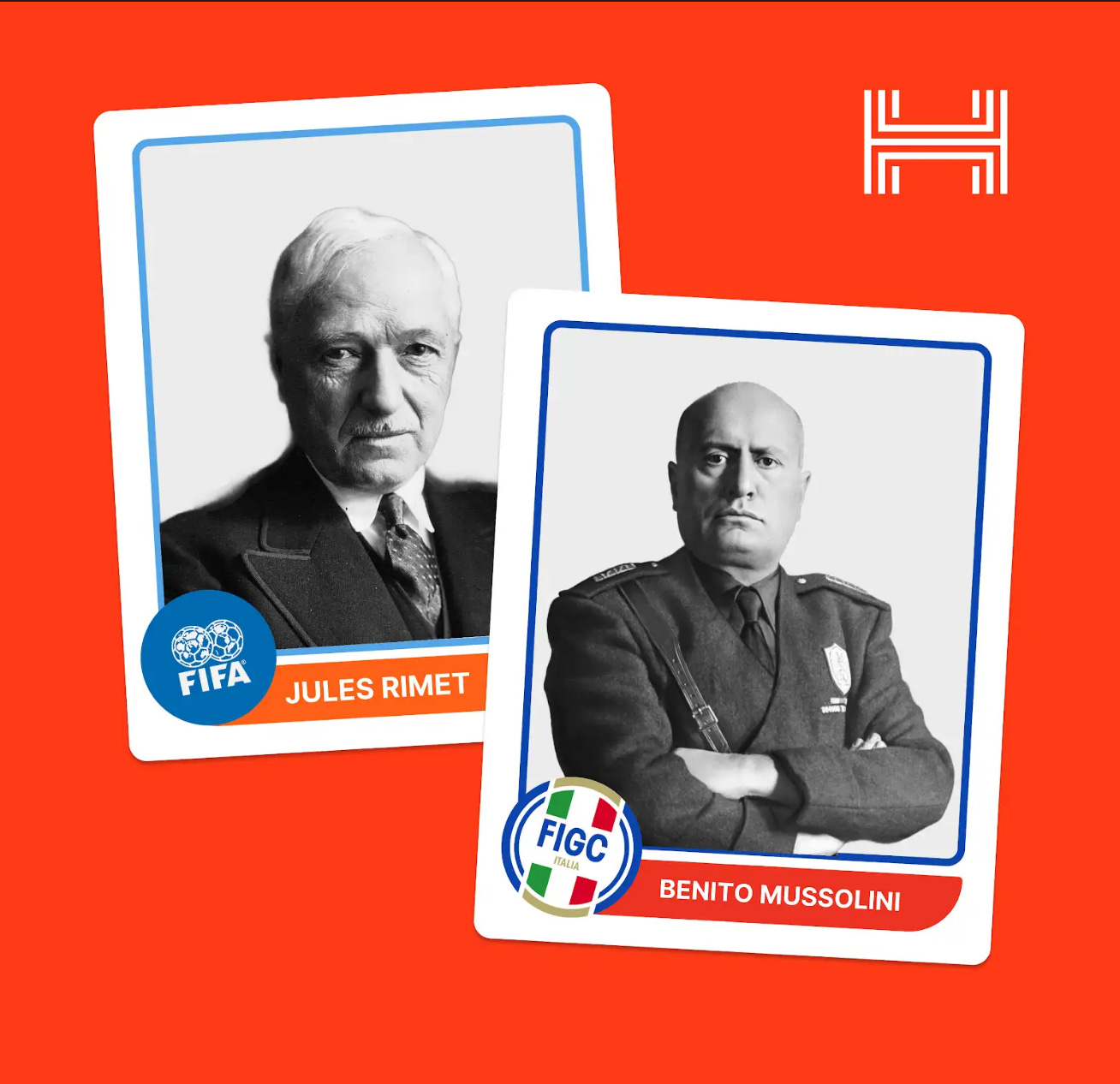
Even the World Cup was itself an experiment. And no one understood the implications of this moment better—or earlier—than Benito Mussolini.
When his Black Shirts seized power in 1922, Mussolini recognized that mass politics in the twentieth century required mass spectacle. Consent had to be manufactured emotionally, not just enforced violently. Sport, and football in particular, offered an unparalleled vehicle. It mobilized crowds without coercion, loyalty without argument, and pride without explanation.
The fascist regime set about transforming Italy into a “sports nation.” Football stadiums were built as monumental public spaces designed to awe the masses. Mussolini carefully cultivated his own image as a virile sportsman, embodying the hypermasculinity of the fascist “new Italian.” In 1937, the French magazine Vu famously placed a shirtless Mussolini on its cover beneath the headline “Mussolini: Sporting Dictator,” capturing the fusion of power, body, and spectacle that defined his rule.
When FIFA awarded Italy the right to host the 1934 World Cup, Mussolini immediately grasped what FIFA’s own leadership barely understood: that the tournament could be more powerful than any diplomatic summit. The World Cup was not merely a sporting competition; it was a stage—a stage to present the power of fascism.
Listen to Episode 1 of Power Plays for more about the 1934 World Cup.
Sports Politika is a media platform dedicated to the intersection of sports, power and politics. If you like what you see, upgrade to a paid subscription ( or gift a subscription if you already have your own). We would appreciate if you could also like the post and let us know what you think in the comment section below.


