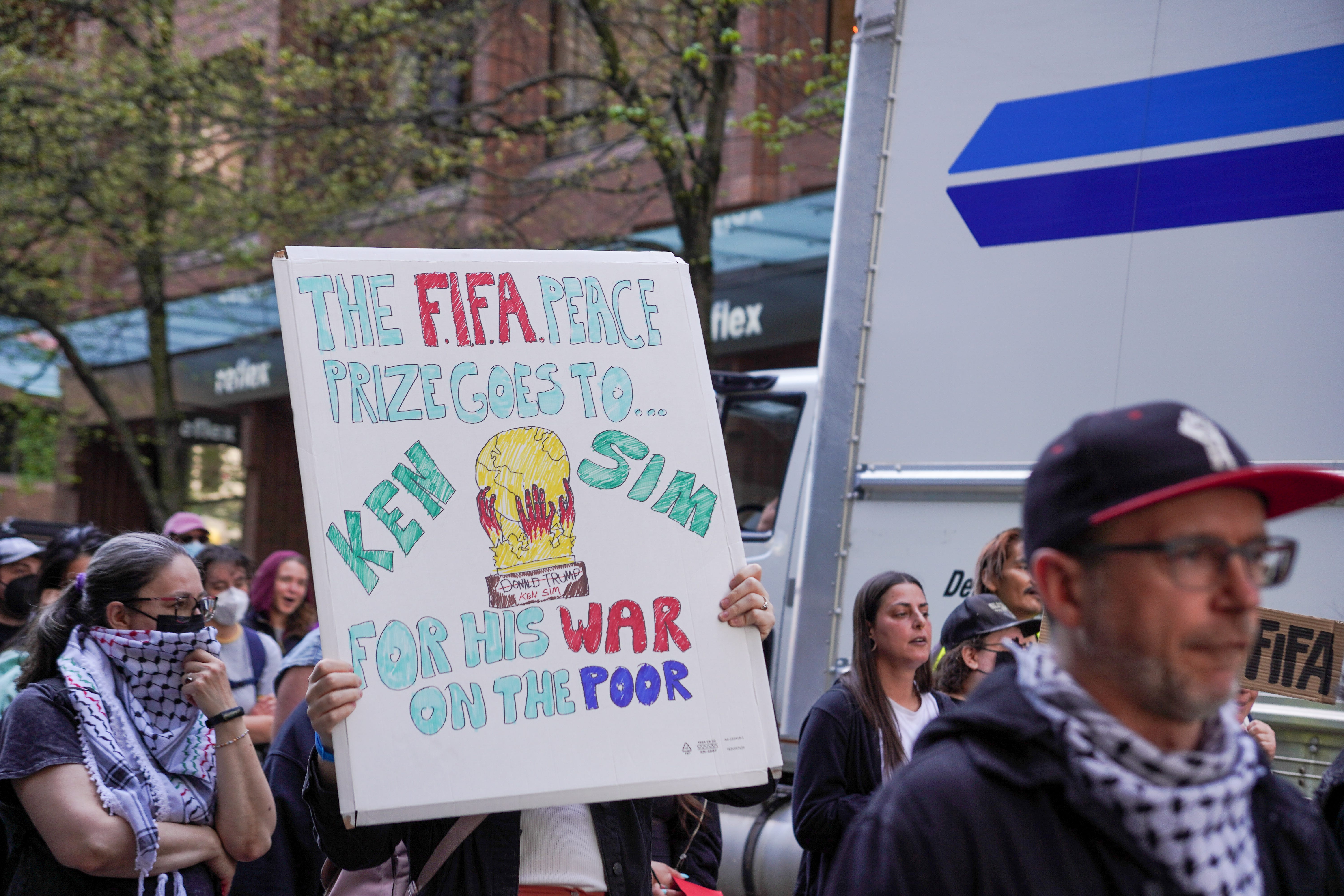
Who Is This World Cup For?
As Vancouver gears up for the World Cup, Downtown Eastside residents are being displaced from their homes, and the city is deploying its largest police force ever.
Welcome to Sports Politika, a media venture founded by investigative journalist and researcher Karim Zidan that strives to help you understand how sports and politics shape the world around us. My mission is to offer an independent platform for accessible journalism that raises awareness and empowers understanding.
If you share this vision, please consider supporting my work by joining becoming a paid subscriber. We are currently offering 60% off annual subscriptions to celebrate Sports Politika’s third anniversary. Don’t miss out!
Kirsten Lebrun has worked at the Pan Pacific Hotel in downtown Vancouver for thirteen years. She has served guests through a pandemic, labour disputes, and the slow, grinding process of negotiating the first union contract. Since February 2021, Lebrun and her colleagues have been part of UNITE HERE Local 40, which represents workers in the hotel, food service, and airport industries throughout British Columbia.
“Our last [interim] contract ended in June of last year. It’s been almost a year with no contract and almost two years with no raise,” said Lebrun.
She was one of dozens of workers who marched outside the hotel, across from the Vancouver Convention Centre, where football officials were gathered for the 76th annual FIFA Congress on April 30. Pan Pacific was one of the three hotels where delegates were staying for the event, considered the kickoff to this summer’s World Cup. According to Lebrun, the hotel is projected to bring in around $45 million from pre-bookings alone, driven by a record-breaking cruise season and the upcoming FIFA World Cup, which features seven matches in Vancouver.
Yet, Lebrun and her colleagues are still fighting for an agreement with fair wages and working conditions that allow them to afford the city they live in.
“With the price of gas, food, rent, mortgage rate and everything that’s going on. It’s just not sustainable to be left behind,” she said. Their dispute is part of a broader movement in the province’s hospitality sector, marked by a recent wave of unionization, strikes and pressure campaigns.
In the last nine months alone, five new Metro Vancouver hotels have voted to join the union. After months of organizing, workers at the Hyatt Alberni secured an agreement in December 2025 that included a pension, job security provisions, and wages up to $40 an hour. In Victoria, Coast Victoria Hotel workers struck for 77 days, in what became the longest hotel strike and lockout in the city’s history, before winning wage increases of up to 21 per cent in November 2025.
The last two times that Lebrun and her colleagues rallied, their employer called them immediately after and set up negotiations. But talks largely stalled.
“We just want to be at the same level as the other hotels,” she said. “We’re far behind, and they have not kept up with inflation.”
The rally outside the Pan Pacific was one of two protests that converged on the FIFA Congress in late April. Steps away, a coalition of Downtown Eastside advocates, including housing lawyers, harm reduction workers, and police oversight groups, held a press conference outlining their concerns.
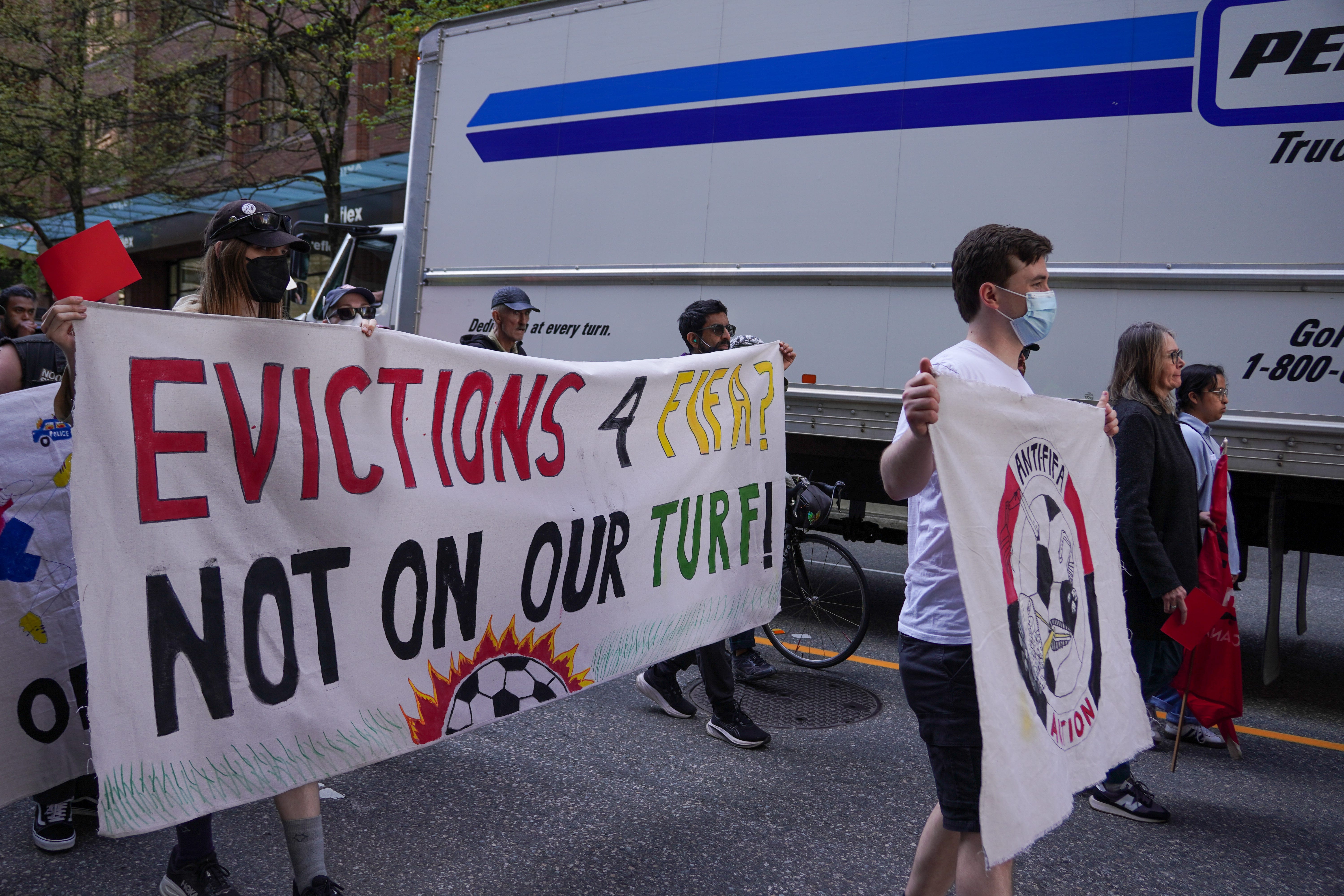
The Downtown Eastside is one of Vancouver’s oldest and poorest neighbourhoods, sitting in the shadow of BC Place Stadium, where the games will be played. Home to generations of low-income residents, Indigenous people, and people experiencing homelessness, it is also one of the most overpoliced and surveilled communities in Canada. Residents are subjected to frequent “street sweeps,” during which city workers, often accompanied by police officers, move through the neighbourhood, clearing people’s tents, makeshift homes, and personal belongings, and throwing them into garbage bins or trucks. Many lose essential items, including medications, ID, clothing and even irreplaceable items like Indigenous art and the ashes of deceased loved ones. While the city insists it has no plans to displace people for the World Cup, critics see it otherwise.
“In assuring that it won’t sweep the streets to prepare for FIFA, the City is actively denying the reality that it already carries out these sweeps every day, perpetuating cycles of displacement, dispossession, and harm,” wrote Pivot Legal Society, which is one of the groups that are part of the anti-FIFA coalition in Vancouver.
The World Cup might not be responsible for introducing sweeps to the neighbourhood, but it only accelerates them, giving the city a reason to continue this controversial practice.
“There is a street sweep probably happening right now as we are speaking, and FIFA isn’t even happening yet,” said Chantelle Spicer, co-director of the BC Poverty Reduction Coalition, which is also part of the anti-FIFA coalition.
A new temporary FIFA bylaw, in effect from May 13 to July 20, is designed, in part, to ensure Vancouver presents a ‘clean and welcoming environment,’ which the city says refers to sidewalk repairs and the decoration of construction sites. But it also gives the city expanded powers over street vending, noise, and graffiti removal within two kilometres of the stadium. In the DTES, which is within that zone, it is common to see residents selling clothing, electronics, and other goods on sidewalks, part of the neighbourhood’s survival economy, which is now restricted by the new bylaw.
“We know already that bylaws are enforced in a discriminatory way, especially in the Downtown Eastside,” said Laura Macintyre, lawyer at Pivot Legal Society.
Both speakers also questioned the gap between what the World Cup promises to deliver and who ultimately pays the cost of hosting the games.
“While all levels of government are stating there is no funding for the social safety net, including desperately needed affordable housing, we see hundreds of millions of dollars being poured into hosting the World Cup,” said Spicer. “We are here to remind people that our city is not a playground.”
The estimated price tag for Vancouver is between $532 million and $624 million, excluding renovations to BC Place Stadium. For the coalition, this level of spending stands in contrast not only to the underfunding of social services but also to what they see as an organized effort to clear the city’s most vulnerable residents from public view before the tournament begins.
Last month, The Globe and Mail reported that Wayne Boucher, who had been sheltering under the Cambie Bridge near the stadium, was told by police that he could not return within two kilometres of the venue.
“Even just being down here the last couple of days, we see the kinds of police presence that we’re going to have during the games – police boats out in the water, numerous security details, all kinds of surveillance,” Spicer said.
Security is expected to be the highest cost of hosting the games in Vancouver, with the city earmarking at least $246 million for integrated public safety, traffic and stadium management in and around BC Place. VPD Deputy Chief Don Chapman described it as the city’s largest police deployment to date, bringing in an additional 800 officers, including RCMP, Delta Police, and forces from Calgary and Edmonton.
The city has also installed about 200 new FIFA-mandated surveillance cameras near the stadium, with footage to be shared with FIFA and private security, raising questions from community organizations about data privacy and civil liberties.
In the main entertainment district on Granville Street, the province and the city announced plans to close three single-room-occupancy hotels, displacing 300 residents from one of the last rungs of affordable housing.
BC’s Housing Minister Christine Boyle specified that these hotels are not long-term solutions, citing poor living conditions. Boyle, who worked at a Downtown Eastside shelter during the 2010 Winter Olympics, has previously talked about witnessing the impacts on vulnerable residents firsthand. She said that her ministry is working with housing providers to find alternative options for residents in one of the hotels that is closing days before the games.
“We know suddenly closing SROs will push people into homelessness and encampments – that is not an outcome anyone wants,” she said in a LinkedIn post about the announcement.
But Vancouver has run this play before. In the months leading up to Expo 86, more than a thousand low-income residents were evicted from their SROs, sometimes with just a day’s notice, to clear rooms for the millions of tourists expected at the world’s fair. Among them was Olaf Solheim, an 85-year-old retired logger who had lived at the Patricia Hotel for decades. When Solheim refused to leave, his landlord removed the door from his room. He eventually found new housing, but he became despondent, stopped eating, and died within a month. Vancouver’s chief medical health officer at the time blamed the eviction.
“He’d been moved from where he was to a place he didn’t want to be, and he simply lost his will to live, and he died,” said Dr. John Blatherwick.
In 2010, the city followed up by hosting the Winter Olympics, and the neighbourhood once again became the frontline of the city’s policies. Starting in 2008, Vancouver police conducted a ticketing blitz targeting bylaw infractions such as jaywalking, loitering, and street vending. They issued double the number of tickets – Ninety-five per cent of which were issued within a four-block radius of the Downtown Eastside. Residents who could not afford to pay the fines were punished further through arrest warrants and no-go orders, banning them from the neighbourhood.
The province also passed the Assistance to Shelter Act, which empowered police to physically remove people from the street to shelters during extreme weather. Advocates refer to it as the “Olympic Kidnapping Act.”
Forty years later, the cost of hosting such mega-events is being borne by the same communities. The Expo put Vancouver on the map, transforming the city’s economy – global investments soared, luxury developments boomed, and property values climbed. But the city’s low-income residents were priced out, pushed into an ever-shrinking corner of the city. Some Vancouverites remember Expo 86 as the moment the city sold its soul.
The core question about who benefits from the World Cup and who the games are actually for has emerged as a central theme of this year’s tournament, with FIFA facing increasing criticism over the cost of World Cup tickets. Tickets range from USD $60 to $11,000, making these the most expensive tickets ever offered at the tournament. In comparison, the most expensive ticket in Qatar’s 2022 World Cup was $1,600.
Fan advocacy organization Football Supporters Europe branded the pricing structure “extortionate” and a “monumental betrayal,” with the last four tickets to the final game sold for $2.3 million each. This is also the first time that FIFA has used dynamic pricing for ticket sales, where prices fluctuate in real time based on demand, the same model used for airline seats and hotel rooms.
Last week, FIFA President Gianni Infantino responded to the criticism, pointing out that there are both expensive and affordable tickets and that higher-priced resale tickets aren’t FIFA’s fault.
“If tickets are appearing on resale sites at a higher price, it does not mean they’re the actual cost of the ticket,” he said. “And if somebody buys a ticket for the final for $2 million, I will personally bring him a hot dog and a Coke to make sure that he has a great experience.”
What he didn’t mention was FIFA’s 30 per cent commission on every resale. For fans hoping to watch Canada play at home in Vancouver, resale tickets to BC Place matches are listed at up to $9,000 each. But for most residents and workers in the city, it has never been just about tickets.
Vancouver’s Host City Committee, responsible for producing the city’s human rights action plan for the tournament, is set to release it next month. The coalition, with Pivot Legal Society and the BC Civil Liberties Association, which has viewed a draft of the plan, says it relies on existing failing frameworks and adds no new protections for those most at risk from the tournament’s impacts.
“The host city committee and the city of Vancouver have been very opaque in their organizing of this event,” said Spicer, co-director of the poverty coalition. “They have left a lot of people in Vancouver wondering exactly how this is going to impact them and how it’s going to benefit them.”
Outside the Pan Pacific, Lebrun wasn’t waiting for answers.
“We chose today to show the hotel that we know there are a lot of people there because FIFA is coming up,” said Lebrun. “We’re just letting them know now that we can make a contract before. We could all settle it, be happy, and move forward. We could all make money. But now is the time — or else.”
Sports Politika is a media platform dedicated to the intersection of sports, power and politics. If you like what you see, upgrade to a paid subscription ( or gift a subscription if you already have your own). We would appreciate if you could also like the post and let us know what you think in the comment section below.