

The UFC-Trump machine is just getting started
The UFC White House event looked like the final triumph of the UFC-Trump alliance. But it was actually something more consequential: the first act in a darker chapter of American politics.

Welcome to Sports Politika, a media venture founded by award-winning investigative journalist Karim Zidan that strives to help you understand how sports and politics shape the world around us. My mission is to offer an independent platform for accessible journalism that raises awareness and empowers understanding.
If you share this vision, please consider supporting my work by joining becoming a paid subscriber.
For all the pyrotechnics, pageantry, and nationalist kitsch that defined the UFC Freedom 250 event that took place on the south lawn of the White House, the night’s most ominous moment occurred shortly before the main event when the UFC unveiled a TV ad for the rebranded U.S. Department of War.
The ad showed members of the armed forces jumping out of planes, invading beaches, and dropping bombs, all to an ominous cinematic score. A voiceover from Pete Hegseth announced that “America is winning” while Trump parroted his presidential mantra “peace through strength.”
“Through our power and might we will lead the world to peace,” Trump says in the ad. “Our friends will respect us, our enemies will fear us, and “the whole world will admire the unrivalled greatness of the U.S. military.”
This single ad perfectly summed up the UFC White House spectacle: a night that blended patriotism with bloodlust, and cagefighting with bellicism.
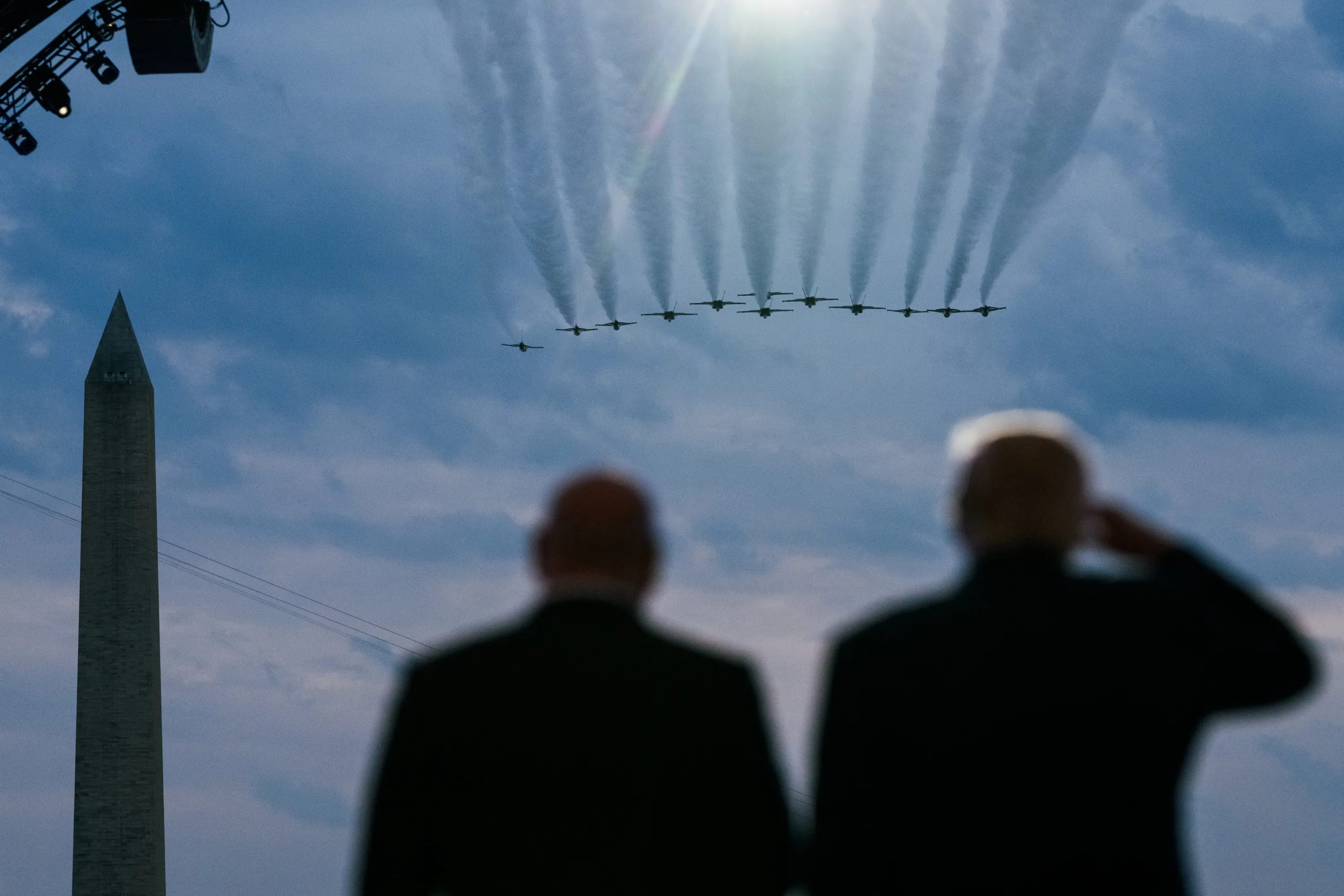
After fears that rain would wash out the event dispersed along with the clouds that bore those bad omens, the event began with UFC CEO Dana White and U.S. President Donald Trump making the walk through the White House together before arriving at a balcony where Trump saluted the crowd as military aircrafts flew low over the event.
The production was unlike anything the UFC had produced in the past. The fighters walked through the White House and down a military honour guard corridor while United States Marine Band serenaded the crowd with renditions of songs like “YMCA”. There were drone shots of the Washington Monument, fireworks displays, ring-card girls dressed like Wonder Woman and Supergirl, and thousands of rowdy service members chanting “U-S-A”—all beneath a 92-foot structure dubbed “The Claw” that engulfed the makeshift arena.
The list of VIP attendees was extensive. There were tech tycoons like Meta CEO Mark Zuckerberg; athletes like boxer Terence Crawford, football legend Zlatan Ibrahimović, and WWE star Roman Reigns; and a cast of Trump officials and cabinet members. UFC owner Ari Emanuel played the role of mediator as he ushered guests to meet with Trump between fights. This included Paramount Skydance CEO David Ellison, whose company had the exclusive broadcast rights for the UFC White House event (after paying $7.7 billion for longterm UFC broadcast rights in 2025). Ellison likely had kind words for Trump, whose Department of Justice recently approved Paramount’s $110 billion takeover of Warner Bros, which would further consolidate American media and establish one of the largest global entertainment businesses in the world.
Beyond the White House perimeter, at the Ellipse, tens of thousands of fans gathered to watch the spectacle, which consisted of seven fights. There were also countless ads from the UFC’s lucrative sponsors like Crypto.com, RAM trucks, and Monster Energy drinks. There were also a few new sponsors like World Liberty Financial, the Trump financial business plagued by scandals, which offered $250,000 in performance bonuses for deserving fighters on the card. The partnership placed an even brighter spotlight on the financial dealings between the UFC and Trump, who also bought shares in TKO before the White House event.
The other is Anduril, a controversial defense tech start-up known for developing AI-powered war machines and sentry towers used to surveil the U.S.-Mexico border. Named after the sword in The Lord of the Rings and valued at over $60 billion, Anduril was featured in ad spots, and had its logo was emblazoned on the Octagon canvas along with the words “fight unfair.”
Anduril is a key beneficiary of the Trump administration’s ongoing effort to re-industrialize the U.S. military. The company secured a 10-year U.S. Army enterprise contract and acquired missile tracking and intelligence firm ExoAnalytic Solutions in an attempt to scale its capabilities and win future contracts for Trump projects such as the “Golden Dome” missile defense system.
Anduril, UFC, and our Dystopian Future

Anduril, the UFC’s new defense tech partner, wants to transform warfare & surveillance with AI—and host military-themed boxing events.
As part of its deal with the UFC, Anduril will work with Zuffa Boxing—the UFC and Saudi joint effort to reshape boxing— to stage military-themed boxing events. Military boxers will compete on the official fight card before fellow service members and supporters, with tickets distributed broadly throughout the military community. While this may sound absurd, it signals an emerging power nexus in the U.S. that fuses the military-industrial complex with cage-fight politics.
While the organization may have spent a reported $60 million to pull off the show, it recouped millions in sponsorship deals for the event, and even secured some new partnerships in the process. This included a memorandum of understanding with the U.S. Department of State to begin “sports diplomacy” initiatives, further integrating the UFC into official government policy and soft power strategy.
“UFC athletes and coaches will serve as sports ambassadors through the Department of State’s Sports Envoy program, which will include leading training clinics for young international athletes,” read a portion of the State Department press release.
Meanwhile, the UFC has also been lobbying Congress to pass the Muhammad Ali Boxing Revival Act, which would effectively modify existing legislation that protects boxers from exploitative promoters to allow Zuffa Boxing to implement the UFC’s exploitative business model in boxing. The bill passed the House with bipartisan support, including from former MMA fighter-turned-Democrtic congresswoman Sharice Davids, but may face difficulty in the Senate. However, with Trump’s support, the bill is likely to pass, further cementing the UFC’s stranglehold over combat sports.
During Trump’s first term, the UFC began propagating the lie that the U.S. president was instrumental to the UFC’s survival during a dark period in its history. It is a lie that continues to be repeated, including by mainstream outlets that should know better. By 2020, the UFC actively campaigned for Trump, and, when he attempted to steal the election and incited an insurrection, helped rehabilitate his image by welcoming him back on UFC broadcasts. It was here that Trump truly came to appreciate the UFC’s cultural cache and its sway over young, apathetic men in a post-Covid world, and rode that wave back to the White House in 2024.
Since then, the UFC has been rewarded handsomely for its loyalty, not least by becoming the first professional sports brand to host an event at the White House. And though the White House event may appear as though it is the final triumph of the UFC-Trump alliance, it is actually the first act of an entirely new, darker, chapter—one which boils down to a single governing principle: might is right.
This is not an accident. The UFC presents itself as a meritocracy; an arena where the toughest person reigns supreme, and where underdogs can have their shot at glory if they work hard enough. This is in keeping with the conservative pick-yourself-up-by-your-bootstraps mentality, where individual success trumps the collective good. Look no further than the UFC Freedom 250 main event, where Justin Gaethje pulled off an American upset for the ages.
Despite entering the cage as a 6-1 underdog, Gaethje battered Ilia Topuria so thoroughly that Topuria’s corner threw in the towel after the fourth round. It was a shocking end to the reign of an undefeated champion widely regarded as the best fighter in the world.
Gaethje was supposed to have no chance. He won anyway. That is the enduring appeal of mixed martial arts: on any given night, the impossible can become inevitable.
And, according to Gaethje, that logic is quintessentially American. So is the violence.
“I’m from America,” he said after the fight. “Two hundred and fifty years ago we were way bigger underdogs and look at us thriving now.”
Sports Politika is a media platform dedicated to the intersection of sports, power and politics. If you like what you see, upgrade to a paid subscription (or gift a subscription if you already have your own). We would appreciate if you could also like the post and let us know what you think in the comment section below.