

When the World Cup Became America First
By aligning with FIFA and steering preparations, Donald Trump has turned football’s global spectacle into a tool for his MAGA vision.

Welcome to Sports Politika, a media venture founded by investigative journalist and researcher Karim Zidan that strives to help you understand how sports and politics shape the world around us. Our mission is to offer an independent platform for accessible journalism that raises awareness and empowers understanding.
If you share this vision, please consider supporting us by joining our community and becoming a paid subscriber.
After Chelsea delivered a masterful performance against Paris Saint-Germain at the 2025 FIFA Club World Cup final in July, the trophy ceremony should have been a straightforward affair.
Standing on a raised dais on the pitch, Chelsea captain Reece James received the winner’s trophy, as his teammates gathered around him for the climactic lift. But after presenting the championship trophy alongside FIFA president Gianni Infantino, Donald Trump continued to linger on stage, even as Infantino quietly departed.
The pause that followed was awkward enough to be visible on television, with Chelsea players glancing at one another as if unsure whether to wait for the American president to make his exit. Finally, goalkeeper Robert Sánchez, standing opposite Trump, gave James a signal to proceed.
What followed was a tableau both celebratory and oddly incongruous: Chelsea’s jubilant squad clustered around their captain, the president of the United States standing directly at the center of the shot, as though he too were part of the team’s triumph.
Chelsea may have stolen the show on the pitch, but Trump had found a way to remain the centre of attention.
The incident baffled several of the players, who couldn’t make sense of the president’s prolonged presence.
“I knew he was going to be here, but I didn’t know he was going to be on the stand when we lifted the trophy, so I was a bit confused,” said Cole Palmer, who was named the player of the tournament.
The absurdity did not end there. Footage from the celebration appeared to show Infantino giving Trump a winner’s medal to look at, which he promptly pocketed in his suit blazer. Even the championship trophy was a replica of the original trophy that Trump insisted on keeping in the Oval Office.
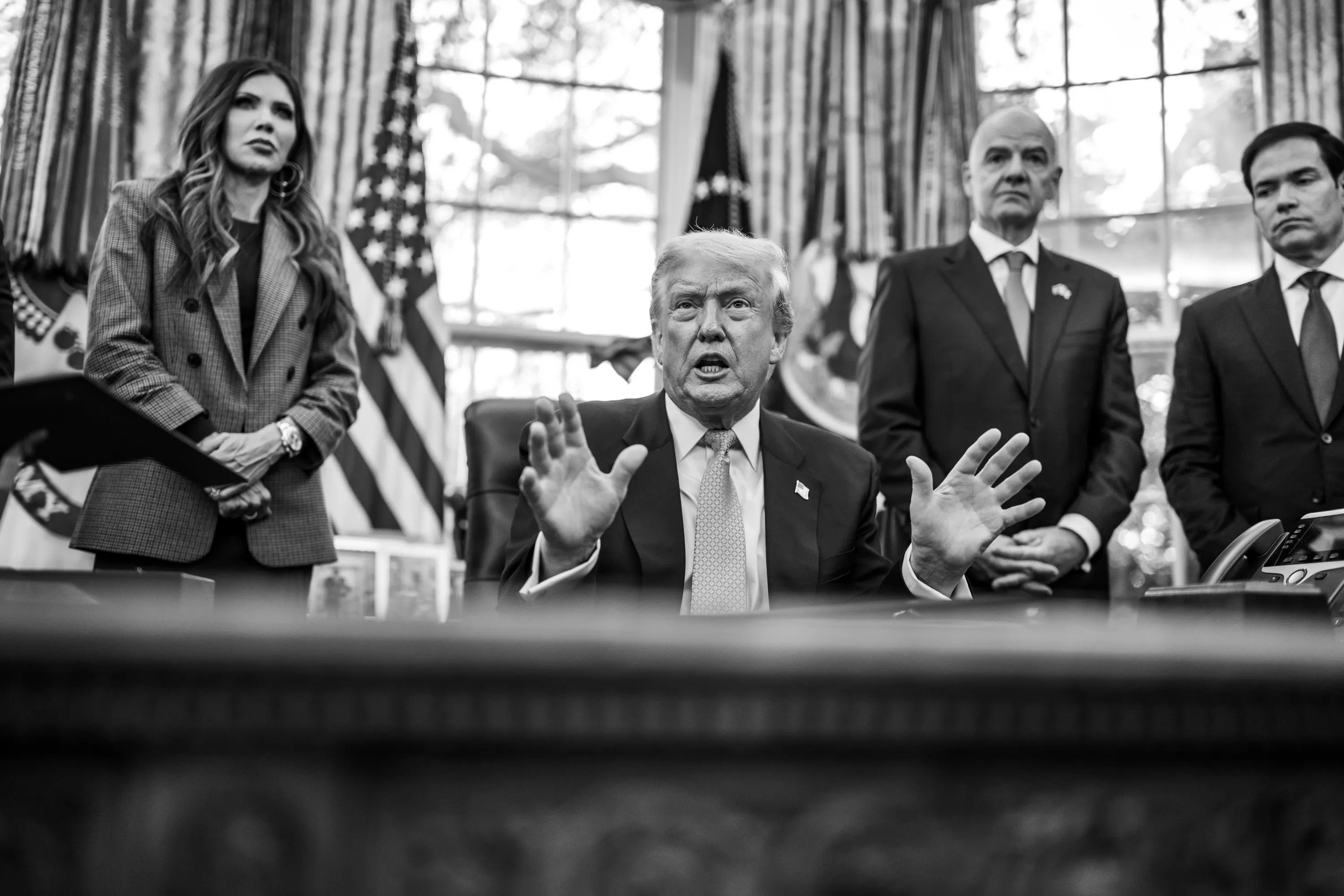
Meanwhile, the event had all the makings of a Trump spectacle. Attorney General Pam Bondi and Homeland Security Secretary Kristi Noem – the woman responsible for the government’s crackdown on immigration – were also in attendance alongside the president.
While the Club World Cup was billed as both the debut of FIFA’s revamped tournament and a trial run for America’s ability to host the 2026 World Cup, the event quickly revealed itself as something else entirely: a MAGA-tinged spectacle, blending politics, entertainment, and cultural symbolism in a way that feels more like an unabashed display of American exceptionalism than a sporting event..
Far from a neutral showcase of sporting infrastructure, it highlighted the unusually close ties between the U.S. government and FIFA’s leadership and offered an unmistakable preview of how Trump and his administration are likely to leverage the World Cup for their “America First” ambitions.
The rise of Trump and Infantino after FIFA’s corruption scandals
To understand how this dynamic took shape, we need to look at the parallel rise of Trump and FIFA president Gianni Infantino – two figures who built their power on controversy and populist appeal – and how their paths converged for the 2026 World Cup.
In May 2015, the U.S. Department of Justice unveiled a sweeping corruption case in world football. At its request, Swiss police raided the Baur au Lac hotel in Zurich during the FIFA Congress and arrested seven senior football officials. The same day, the FBI and IRS-CID searched CONCACAF’s headquarters in Miami.
In total, 14 individuals – including FIFA officials and sports marketing executives – were charged with racketeering conspiracy, wire fraud, and money laundering involving more than USD 200 million in bribes and kickbacks.
In 2015, the American FBI stepped up to police the scandals in FIFA and the regional American football federation, Concacaf. Ten years later, the relationship between the U.S. and FIFA is entirely different. Photo: Joe Skipper / Getty Images
The probe centred on claims that FIFA executives accepted millions of dollars in kickbacks in exchange for awarding lucrative media rights as well as the hosting rights for the World Cup. The U.S. Department of Justice unsealed indictments against more than a dozen officials, describing FIFA as operating like a criminal enterprise.
Among the most scrutinized deals were the bids that awarded the 2018 World Cup to Russia and the 2022 tournament to Qatar, which investigators alleged were marred by vote-buying schemes and financial inducements.
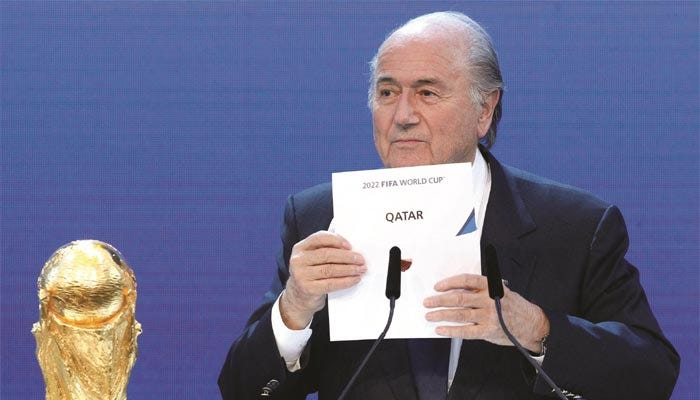
The scandal shook world football, leading to a wave of arrests in Zurich and the resignation of long-time FIFA president Sepp Blatter.
The following year marked a dramatic shift. In February 2016, Gianni Infantino was elected FIFA president, triumphing over the Asian Football Confederation President Sheikh Salman bin Ebrahim al-Khalifa by campaigning on a platform of reform and transparency. He promised to clean up the organisation’s reputation and steer it away from the corruption scandals of the Blatter era.
“I want to be the president of all of you. I travelled through the globe and I will continue to do this. I want to work with all of you to restore and rebuild a new era where we can put football in the centre of the stage,” Infantino told the delegates following his victory. “Fifa has gone through sad times, moments of crisis. But those times are over.”
Nine months later, in November 2016, Trump was elected president of the United States of America, ushering in an administration with a very different approach to global engagement. Where the FBI investigation had framed FIFA as a case study in transnational crime and an example of U.S. willingness to police global institutions, Trump’s administration had other plans. Instead of isolating FIFA, his administration would soon seek to work with its leadership.
Almost as soon as he arrived in the White House in early 2017, Trump and his administration began championing a goal far removed from policy briefings or legislative battles – winning the right to host the 2026 FIFA World Cup.
“They were calling me constantly to try to get me to come onboard, but it only took one call because when I heard “World Cup,” I wanted to do it,” Trump said during a August 2018 press conference with Infantino.
However, their ambition faced a major obstacle in the form of the infamous “Muslim ban”– Executive Order 13769 and its successors – that Trump signed in January 2017, effectively banning foreign nationals from seven predominantly Muslim countries from visiting the U.S.
The executive order was widely condemned as discriminatory and raised international doubts about the United States’ suitability as a host nation. Aleksander Čeferin, then newly elected head of UEFA, European football’s governing body, suggested that Trump’s order could damage any US bid.
“If players cannot come because of political decisions, or populist decisions, then the World Cup cannot be played there,” he told the New York Times.
At the time, Infantino shared a similar opinion, arguing that the president’s policy was incompatible with FIFA’s regulations.
“Teams who qualify for a World Cup need to have access to the country, otherwise there is no World Cup. That is obvious,” Infantino said.
In an attempt at damage control, the Trump administration dispatched letters to FIFA affirming that “all eligible athletes, officials, and fans from all countries around the world would be able to enter the United States without discrimination”.
The administration also revoked and replaced the Muslim ban policy with another executive order that Trump labeled the “watered down, politically correct version” of the initial ban. It would remain in effect until President Joe Biden revoked it in 2021.
In the end, a joint bid between the United States, Canada and Mexico was unveiled on April 10, 2017.
Jared Kushner, Trump’s son-in-law and senior adviser, was pivotal in obtaining support from Saudi Arabia for the U.S.-Canada-Mexico bid to host the 2026 FIFA World Cup. Photo: Pool / Getty Images
Key to securing this contentious win was Jared Kushner, Trump’s son-in-law and senior adviser. Kushner’s behind-the-scenes diplomacy included personal lobbying of Saudi and Bahraini leaders.
In a discreet 2017 visit to Saudi Arabia, Kushner reportedly stayed up until 4 a.m. negotiating with Crown Prince Mohammed bin Salman to secure Saudi support - and influence other Gulf nations to back the U.S.-Canada-Mexico bid over favoured challenger Morocco.
His efforts were described as pivotal, even if publicly downplayed, with reports noting that Kushner repeatedly hosted the U.S. Soccer Federation at the White House to coordinate bid strategy.
Beyond the bid itself, Kushner remained instrumental in shaping the tournament’s final logistics. According to The Athletic, he arranged a strategic lunch bringing together FIFA President Infantino, regional politicians, and major New York business leaders to anchor the MetLife Stadium in New Jersey – home of the 2026 final – as the centerpiece venue.
This kind of elite networking further cemented the infrastructure and political groundwork necessary for Trump’s vision of the World Cup as a successful, high-profile national project.
“We’re going to have to extend my second term because 2026 – I’m going to have to extend it for a couple of years,” Trump told the media before boarding the Marine One helicopter with Infantino in September 2019.
“I don’t think any of you would have a problem with that. But I hope you’re going to remember me in 2026.”
Trump puts his presidency at the centre of World Cup preparations
In May 2025 – four months into Trump’s second term in office – the president hosted the first meeting of the newly minted 2026 World Cup task force.
Established to oversee preparations for the 2026 World Cup, the task force is chaired by Trump and includes most of his cabinet, including Vice President J.D. Vance and Secretary of Homeland Security Kristi Noem.
During the meeting, Trump boasted that the 2026 World Cup will be the “biggest, safest and most extraordinary soccer tournament in history.” During the same meeting, the vice president made clear the limits of hospitality for tourists who visit the US for the tournament.
“We want them to come. We want them to celebrate. We want them to watch the game. But, when the time is up, they have to go home. Otherwise, they’ll have to talk to [DHS] Secretary Noem,” Vance said.
At the first meeting of the 2026 World Cup task force, the American president and vice president extended a warm welcome to football tourists – provided they go home, when the tournament is over.
Vance’s comments are in reference to one of the Trump administration’s core policies: a mass deportation campaign targeting hundreds of thousands of immigrants and, in some cases, U.S. citizens. Under Noem’s DHS leadership, U.S. Immigration and Customs Enforcement (ICE) has been carrying out raids on cities across the country, targeting everything from places of worship to Home Depot parking lots.
In some cases, the administration has used obscure laws such as the 1798 Alien Enemies Act to quickly deport suspected illegal immigrants with limited or no due process. Several hundred were sent to a high-security prison in El Salvador reserved for gang members.
As of April 2025, the Trump administration has claimed to have deported 140,000 people, though data suggests it is roughly half that amount. Nevertheless, the DHS claimed in August that 1.6 million “illegal aliens have left the U.S.”
The Trump administration’s anti-immigrant crackdown even extended to football, as ICE agents attended matches during the Club World Cup.
“As is customary for an event of this magnitude with national security implications, ICE will be working alongside our Department of Homeland Security and Department of Justice partners to help ensure the safety and security of the event,” an ICE spokesperson told The Miami Herald.
Beyond immigration, the Trump administration’s gutting of federal institutions as part of its policy to reduce government spending will likely have a serious impact on the country’s ability to successfully host the 2026 tournament.
According to the U.S. Travel Association, the country’s air travel system is not built to handle the incoming surge of travellers expected ahead of the World Cup and the 2028 Olympic Games in Los Angeles. The association released a report in February 2025, which calls for security reforms, the modernisation of air traffic control technology, and improvements to visa processing.
And then there is the trade war that Trump launched against Canada, its closest ally, and Mexico – both of whom are co-hosts of the 2026 World Cup.
Beyond the economic concerns, Trump’s trade war with the World Cup co-hosts goes against the spirit of an event that has long been propagated as a unifying force. It could also raise security concerns, as the breakdown in diplomatic relations could lead to obstacles in security coordination.
Nevertheless, both FIFA and Trump have continued to present the event as the greatest spectacle in sporting enterprise.
“America will welcome the world. There will be millions of people coming, Mr. President – millions of people,” Infantino said in March 2025.
“And, more than that, we will give joy and happiness to the entire world. And this is priceless, definitely. So, thank you, Mr. President for setting up this task force because it is important that everyone that comes to America feels safe, feels welcome, and that’s why it’s important that the government puts together this White House task force, chaired by the President (of the United States) himself.”
Infantino and Trump forge a political alliance through football
“Football needs responsible leadership, not emperors.”
So declared FIFPro, the global football players’ union, after the 2025 Club World Cup. The statement came in response to FIFA president Gianni Infantino’s decision to exclude the union from FIFA’s discussions about player welfare during the Club World Cup final – another example of the autocratic tendencies that have defined his reign.
But Infantino’s ambitions now extend far beyond football’s internal politics. His most audacious gamble, the 2026 World Cup, has bound him to Donald Trump, for whom football is not just sport but a political instrument.
Trump has always understood sport as a battlefield in the American culture wars. He attacked kneeling NFL players as “unpatriotic,” cast the NBA as “disrespectful,” and presented himself as the lone defender of a traditional, flag-waving vision of American sport. Football, the world’s game, offers him something different: not just a domestic wedge issue but a global spectacle that can be reframed to serve his nationalist narrative.
For Trump, the 2026 World Cup is the perfect stage. It allows him to claim credit for bringing the world to America, to present the U.S. as the indispensable host nation, and to contrast “American greatness” with what he depicts as weak, declining Europe or unstable Latin America.
He can drape the event in patriotic symbols, insist that it proves his “America First” agenda works, and use the tournament’s massive audiences to dominate the domestic political conversation in an election cycle.
Infantino quickly realised Trump’s utility. He cultivated a political bromance with the U.S. president – attending his inauguration, visiting him in the Oval Office, joining him on a Middle East jaunt, and offering gifts tailored to flatter the president’s ego. He even won over the Democratic-led cities that will host the majority of the matches without upsetting his White House allies.
Infantino is a consummate political operator, untroubled by the company he keeps so long as it serves his ambitions. He partnered with the Kremlin to stage the 2018 World Cup, leaned on Qatar’s monarchy to deliver the 2022 edition, and has since aligned himself with Saudi Arabia and its de facto ruler, Mohammed bin Salman – whose backing has underwritten Infantino’s grand projects, including the expanded Club World Cup.
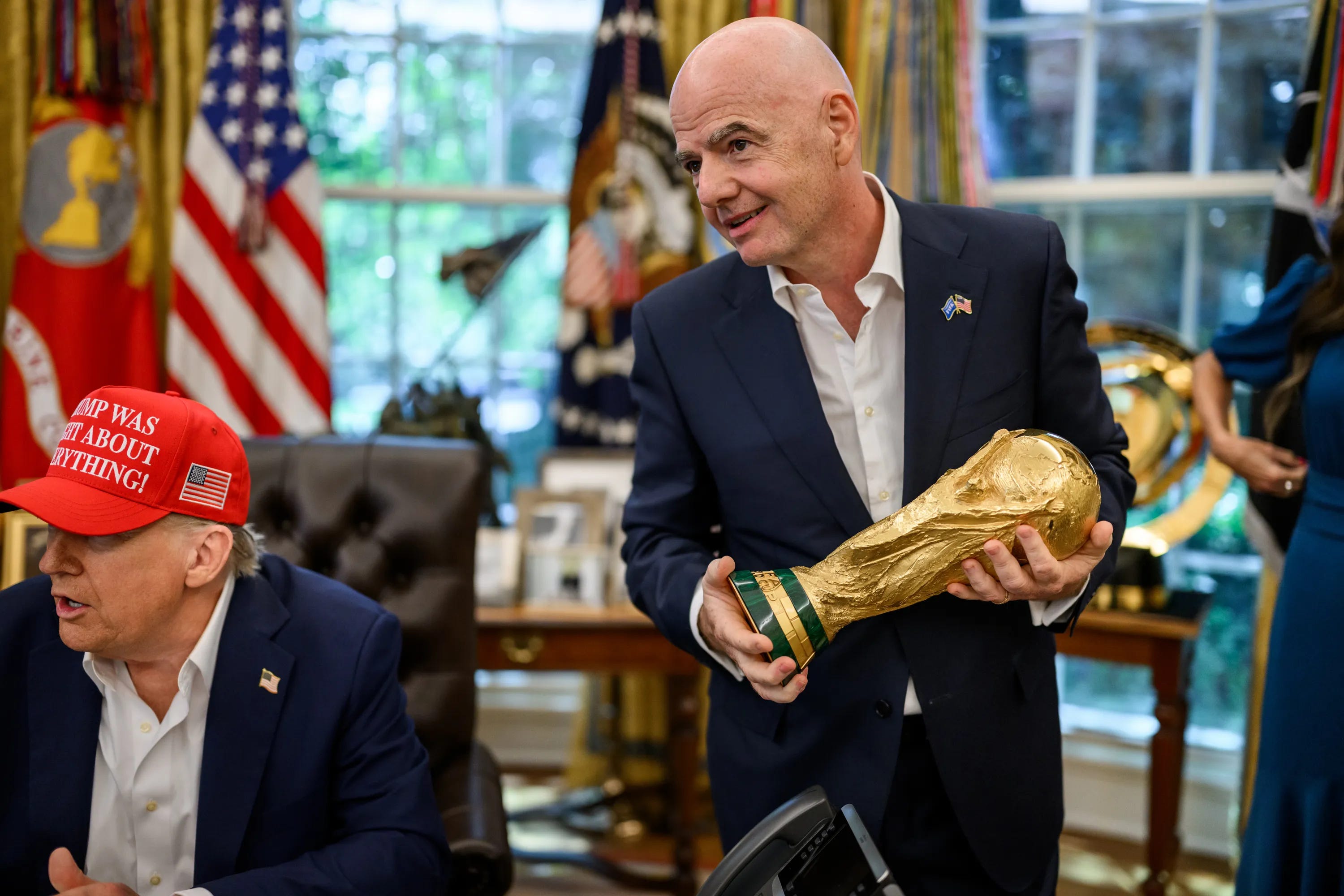
Infantino’s relationship with Trump is similarly transactional but essential: Infantino needs Trump’s blessing to secure FIFA’s place in America, and Trump needs Infantino to deliver the kind of global spectacle he can rebrand as an American triumph.
The mutual dependence is stark. Infantino sees the U.S. as the crown jewel of his “new era of football,” the market that can deliver both revenues and legitimacy. Trump sees FIFA as a propaganda machine – an organisation willing to let him bask in stadium ceremonies, claim symbolic victories, and turn football into another front in the culture wars.
If NFL players’ protests made them villains in Trump’s narrative, the World Cup offers him an opposite symbol: foreign athletes and fans flocking to America, paying tribute – whether willingly or not – to its greatness.
Nevertheless, Infantino’s bet on Trump and the 2026 World Cup isn’t a guaranteed win.
Trump’s crackdown on immigration could chill international attendance figures and weaken the football czar’s claims that the tournament will be biggest spectacle the sport has ever seen. The ongoing trade war between the U.S. and its neighbours and fellow co-hosts Canada and Mexico, could also have a serious impact on the event, dispelling the notion of “unity” that FIFA preaches.
Still, Infantino has defended his closeness with Trump, insisting that maintaining the relationship is essential to the World Cup’s success. In doing so, he has tethered FIFA’s future to the whims of a president who has weaponized sport as a pillar of his MAGA ideology. For Trump, football is not merely a game but a stage – an opportunity to reinforce his political narrative, to claim credit for the tournament’s scale and spectacle.
The World Cup will be marketed as a celebration of football. But at its core, it is a political pact: Infantino’s empire depends on Trump’s blessing, and Trump’s nationalist project finds the perfect megaphone in Infantino’s FIFA.
This article was first published in October 2025 as part of a research project for Play the Game.
Sports Politika is a media platform focusing on intersection of sports, power and politics. Support independent journalism by upgrading to a paid subscription ( or gift a subscription if you already have your own). We would appreciate if you could also like the post and let us know what you think in the comment section below.
Concerned about how the FIFA Peace Prize recipient is selected?
Please add your voice to our petition to FIFA:
https://www.change.org/fifa-peace-prize