


Welcome to Sports Politika, a media venture founded by investigative journalist and researcher Karim Zidan that strives to help you understand how sports and politics shape the world around us. My mission is to offer an independent platform for accessible journalism that raises awareness and empowers understanding.
If you share this vision, please consider supporting my work by joining becoming a paid subscriber. We are currently offering 60% off annual subscriptions to celebrate Sports Politika’s third anniversary. Don’t miss out!
When I was a teenager, I used to sneak onto the roof of my apartment building to smoke joints with my girlfriend and the delightful bunch of delinquents we called friends. The roof itself wasn’t much—a mess of old antennas shaped like flying saucers, an electrical closet, and some dusty, old cement blocks to sit on. What it did have going for it was that, despite being located in the southern suburbs of Cairo, we had a clear view of the Pyramids in the distance, more than 20 kilometres away.
At the time, we all took this remarkable backdrop for granted. We were, after all, more interested in the hash being passed around and whatever teenage drama was happening at that time. The Pyramids were a part of everyone’s backdrop; something you could see when driving to work, or on your way to school. Some hotels and restaurants have a direct view of the Pyramids, yet we never seemed to make a big deal of it. It was just there—as typical as a bowl of koshary or a steaming cup of mint tea.
This isn’t to suggest that Egyptians aren’t fiercely proud of the pyramids and their heritage. Ask any Egyptian you know about the pyramids and they will instinctively puff out their chests with pride as though you just congratulated them on something they personally achieved. We simply lived in their presence for so long that we no longer stood in awe of them. Which is what makes it so surreal to watch as the pyramids transform from a quiet symbol of Egyptian pride and history to a backdrop for everything from raves and concerts, to weddings and, most recently, a Saudi-funded boxing super-fight.
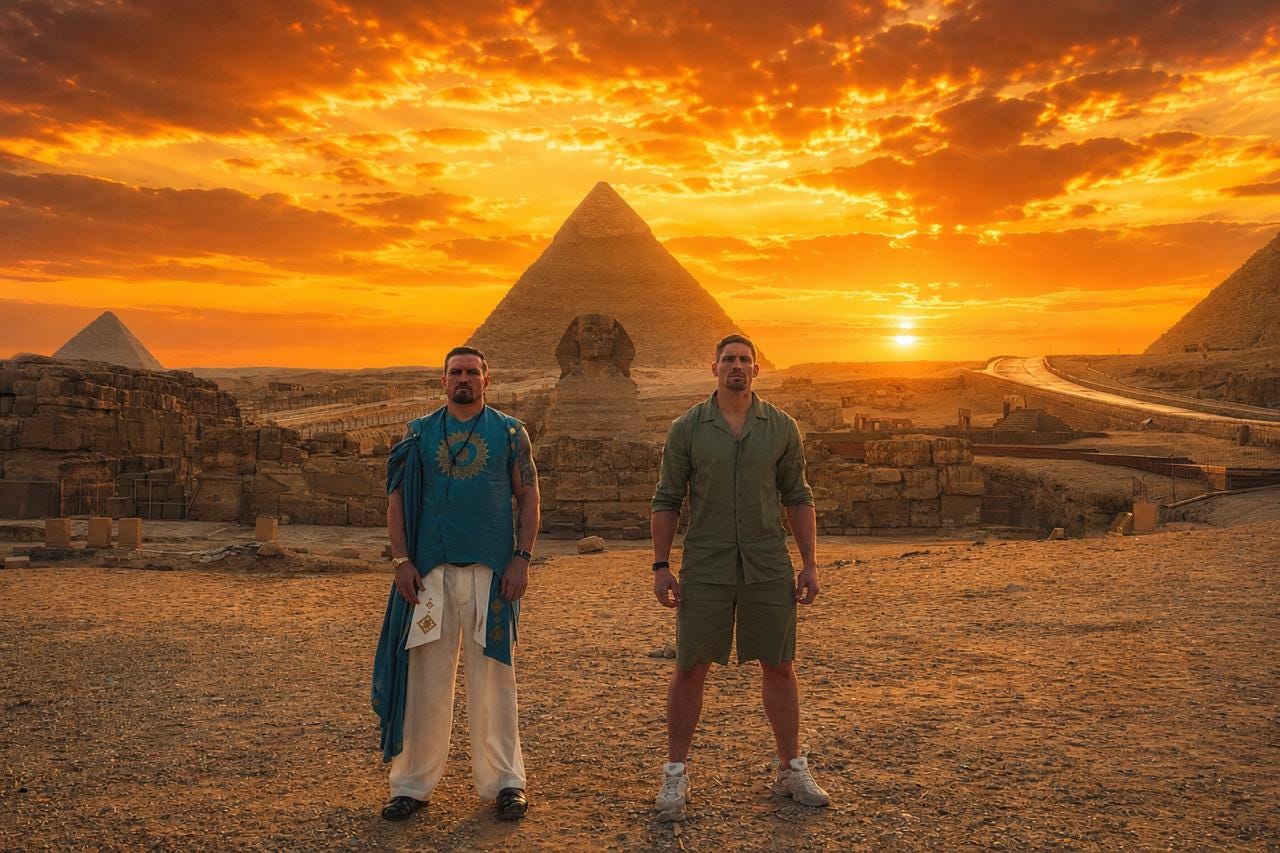
On Saturday night, Oleksandr Usyk retained his world heavyweight titles following a highly controversial 11th round stoppage victory against kickboxing legend Rico Verhoeven. It was just Verhoeven’s second professional boxing fight and, despite being an overwhelming betting underdog, was potentially en route to one of the greatest upsets in boxing history. The chaotic ending capped off a bizarre night at the Pyramids filled with eye rolling ancient Egyptian cliches and motifs, hype videos dripping with AI slop, ridiculously corny walkouts marketed as “iconic.”
I mean, am I wrong?
The architect of this gaudy spectacle was Turki al-Sheikh, one of Saudi Crown Prince and de facto ruler Mohammed bin Salman’s loyal henchmen and the person behind the kingdom’s boxing ambitions. Al-Shiekh, who helms Saudi’s General Entertainment Authority (GEA), has had a massive impact on boxing in recent years, having bankrolled some of the most high-profile heavyweight fights and broken through negotiation stalemates by offering record-breaking sums of money. His success as a promoter has made him one of the sport’s most powerful figures, while fans and media affectionately refer to him as “His Excellency,” — a title that underscores his growing cult of personality.
Al Sheikh’s expanding personality cult and influence has stifled criticism within boxing. Fans are willing to overlook troubling behaviour as long as he continues to deliver exciting matchups, while journalists, eager to maintain their critical access, often frame the narrative in his favour. As Saudi Arabia’s Public Investment Fund (PIF) faces mounting financial pressure—further intensified in the aftermath of the U.S.-Israel war on Iran—Turki Al-Sheikh’s longtime rival, Yasir Al-Rumayyan, appears to be losing his standing as the kingdom’s most influential figure in sports. Al-Rumayyan, the PIF governor who oversaw costly Saudi sports ventures such as LIV Golf, which reportedly incurred more than $5 billion in losses over four years, is increasingly vulnerable, potentially clearing the way for Al-Sheikh to take the reins. A boxing superfight at the Great Pyramids was merely his latest attempt to solidify his status as Saudi’s leading sports and entertainment figure.
Events at the Pyramids are nothing new. In 1978, the Grateful Dead performed a trio of shows there, becoming the first Western band to perform at the ancient site. The following year, Frank Sinatra performed a charity concert at the base of the Great Pyramid of Khufu, at the invitation of Egypt’s president Anwar Sadat. Mariah Carey and the Red Hot Chilli Peppers followed in their footsteps in 2010 and 2019, respectively. Yet over the past couple of years, the Pyramids have hosted a startling amount of raves, from Carol Cox, and Tiësto to the cheesy audio-visual spectacle of Anyma.
The Pyramids have also hosted lavish weddings for some of India’s wealthiest families, sometimes requiring bespoke venues near the ancient wonders. One of those weddings was even profiled in Vogue magazine. These extravagant parties stand in stark contrast to the dire economic conditions facing most Egyptians. After heavy investments in a new administrative capital larger than entire countries like Singapore, the coronavirus pandemic, and other financial mismanagement, Egypt was facing its worst economic crisis in a generation. Had it not been for risky IMF loans and massive investments from the United Arab Emirates, Egypt would have likely been devastated.
The situation has greatly improved over the past year. The country’s GDP is increasing while its credit rating was recently upgraded. Nevertheless, Egypt continues to rely on investments from the Gulf, such as the developments being undertaken by Qatar and the UAE along Egypt’s mediterranean coast, which may dry up if the Iran war does not come to an end. This includes loaning out its heritage so that al-Sheikh can say he put on the first boxing match at the Pyramids. And yet, it isn’t the masterstroke of soft power that al-Sheikh had intended. The Pyramids are far more magnificent than anything Saudi Arabia has to offer, and the fact that al-Sheikh chose that as a backdrop rather than, say, the Saudi desert landscape of Al-Ula, reveals much about the Saudi regime’s psyche: they may have more money than God, but money can’t buy buy culture, and it most certainly can’t buy civilization.
Seated alongside Jason Statham in the front row, al-Sheikh appeared to have his moment on Saturday night. But the truth is, few others in attendance actually liked him. When al-Sheikh was first endowed with a hefty budget as Chairman of the General Entertainment Authority, he decided his first investment would be in Egypt. He offered to invest in Egypt’s Al Ahly, Africa’s most successful football club, and became its honourary president in 2017. Yet following a series of shady decisions, including trading Al Ahly players to Saudi Arabian teams, Egyptians turned on him.
During a now-infamous match in 2018, Al Ahly fans chanted insults at al-Shiekh’s mother. Upon hearing the chants, al-Sheikh resigned from his role and left in disgrace. Eight years later, he remains one of the least liked people in Egypt.
Yet another thing that al-Sheikh can’t buy: respect.
Sports Politika is a media platform dedicated to the intersection of sports, power and politics. If you like what you see, upgrade to a paid subscription ( or gift a subscription if you already have your own). We would appreciate if you could also like the post and let us know what you think in the comment section below.
Such an insightful piece. Thank you for staying loud within the world of combat sports.
I wish al-Sheikh would get those same insults in the combat sports space. Thanks again Karim for a very insightful article.