

Two Flags, a Pair of Boots, and a Matador
Lamine Yamal’s World Cup boots were meant to honour his family roots. Instead, they ignited a debate in Spain over national identity, with critics contrasting the teenage star with a UFC fighter.

Welcome to Sports Politika, a media venture founded by award-winning investigative journalist Karim Zidan that strives to help you understand how sports and politics shape the world around us. My mission is to offer an independent platform for accessible journalism that raises awareness and empowers understanding.
If you share this vision, please consider supporting my work by joining becoming a paid subscriber or by pre-ordering my new book, THE ULTIMATE STRONGMEN.
“I don’t care what Lamine Yamal’s ID says.”
This was the headline of a recent opinion piece in El Español, a prominent outlet with the largest digital reach among all newspapers in Spain, that attempted to challenge talismanic teenage phenom Lamine Yamal’s allegiance to Spain.
“If Morocco were a football power, Yamal would have chosen to play with the Moroccan team, but the flags he would carry on his boots would still be the Moroccan and Guinean, not the Spanish,” wrote Cristian Campos, who serves as editor-in-chief of the paper’s op-ed section.
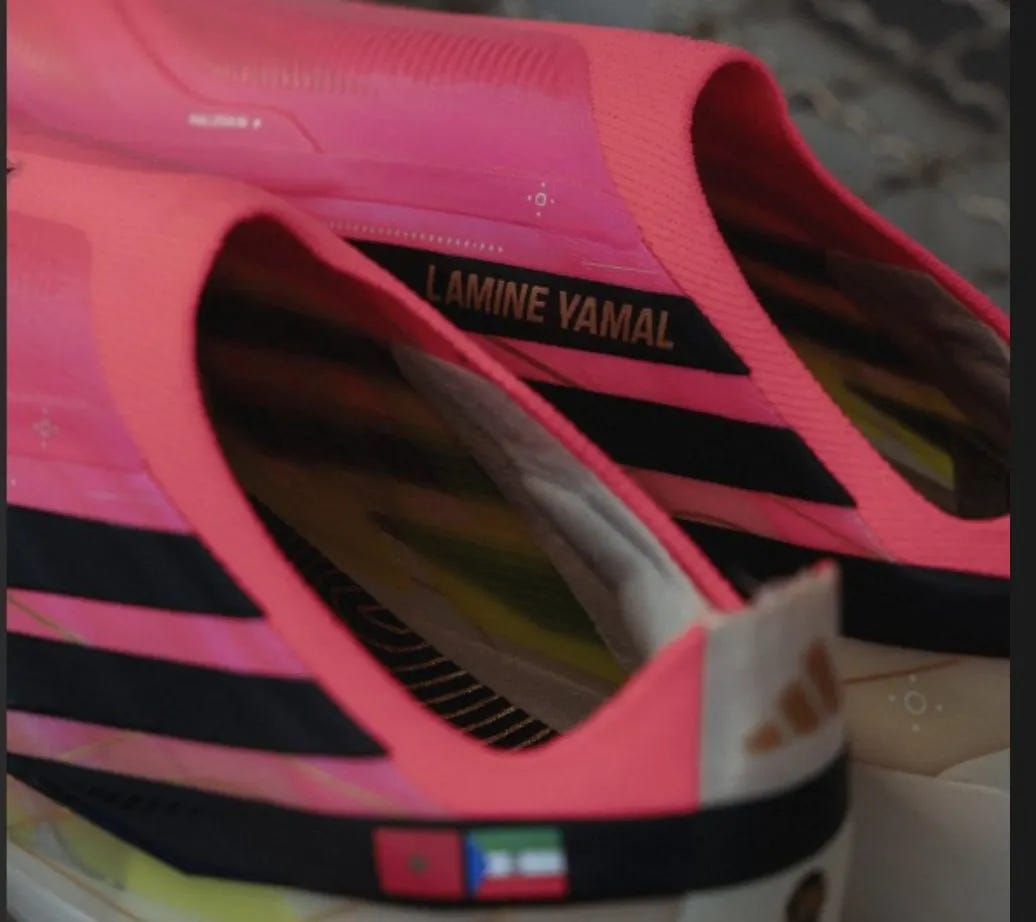
Campos’ comments stem from Spain’s opening game at the 2026 FIFA World Cup, where Yamal appeared in customized football boots that bore the flags of Morocco, in tribute to his father, and Equatorial Guinea, in recognition of his mother’s heritage. The controversy first emerged on social media before being picked up by Spanish media, including Campos.
Born in Barcelona to immigrant parents, Yamal grew up in the working class neighbourhood of Rocafonda, which he continues to pay tribute to making a gesture of the number 304, the last digits of the local postcode, when he scores a goal. He was scouted by Barcelona at age six and grew up playing in the youth ranks of the club’s youth academy. He has remained with Barcelona ever since, and helped lead the team to their 29th La Liga title in May 2026. Yamal has also played for Spain’s senior national team since 2023, when he was still 16 years old. So why is a player born in Spain, and who grew up playing for one of the country’s most popular clubs, facing scrutiny about his national identity?
There are several reasons why Yamal has drawn the ire of Spain’s right-wing media. The 18-year-old is Catalonian, Black, and a practising Muslim who uses his platform to express his personal beliefs. In March, Lamal spoke out agains the “ignorant and racist” anti-Muslim chants that took place during a friendly match between Spain and Egypt in Barcelona. And after Barcelona defeated Real Madrid to win the La Liga title in May, the team’s teenage superstar raised a Palestinian flag during a celebration parade to cheers from the crowd in attendance.
At the time, Lamal’s gesture in support of Palestine drew a visceral response from Israeli officials. Israeli defence minister Israel Katz took to X to accuse Yamal of inciting hatred against Israel and the Jewish people, and demand that the club to distance itself from Yamal’s actions. Spain’s prime minister Pedro Sanchez, one of Europe’s most vocal critics of Israel, responded shortly thereafter, insisting that “those who consider waving the flag of a State to be “inciting hatred” have either lost their judgment or been blinded by their own ignominy.”
Lamine Yamal did nothing wrong

Welcome to Sports Politika, a media venture founded by investigative journalist and researcher Karim Zidan that strives to help you understand how sports and politics shape the world around us. My mission is to offer an independent platform for accessible jour…
Yamal is now embroiled in an nationalist debate that aims to instil doubt about his supposed loyalty to Spain. In his op-ed, Campos argues that Yamal chose to play for Spain because it benefited him professionally and financially, rather than out of a desire to represent the country of his birth. It is an argument built entirely on a cynical assumption with no basis in reality.
Worse, Campos relies on a comparison with former UFC champion Ilia Topuria, who moved to Spain from Georgia as a teenager. His nickname is “El Matador,” paying homage to the Spanish bullfighter, while his entrance music is the iconic Canción del Mariachi from the 1995 film Desperado. And though Topuria represented Spain as one of the best fighters in the world, the argument that he is more worthy of being Spanish than Yamal is nonsensical because it ignores the fact that Topuria is a dual citizen who also represents his Georgian roots. In that sense, he is no different to Yamal.
What is especially strange about this argument is that there are countless players in the 2026 World Cup who could have represented another country. Folarin Balogun, who was born to Nigerian parents and grew up in England, scored two twice in the U.S. opener against Paraguay; 18-year-old Ayyoub Bouaddi switched from France to Morocco ahead of the tournament; Brahim Díaz played one game for Spain before moving over to Morocco; Yasin Ayari plays for Sweden instead of his native Tunisia; Kylian Mbappé was eligible to play for Cameroon or Algeria because of his family background but chose France, where he was born and raised.
These dual national players suit the naysayers and nationalists when their team happens to be winning. When Yamal helped Spain lift the 2024 Euro championship, he was celebrated as a national hero. But when Spain failed to beat a debuting Cape Verde in their opening match at the 2026 World Cup, suddenly it was the perfect time for a debate about a teenager’s shoes.
And yet I keep coming back to Campos’ comparison with Topuria. In his op-ed, he claims there is a distinction between “legal nationality and substantive belonging,” and attributes that distinction to the UFC fighter. For Campos, to be Spanish is to embrace a form of performative nationalism that demands complete integration into the country that welcomed you. Any attempt to challenge that performance gets you branded a traitor.
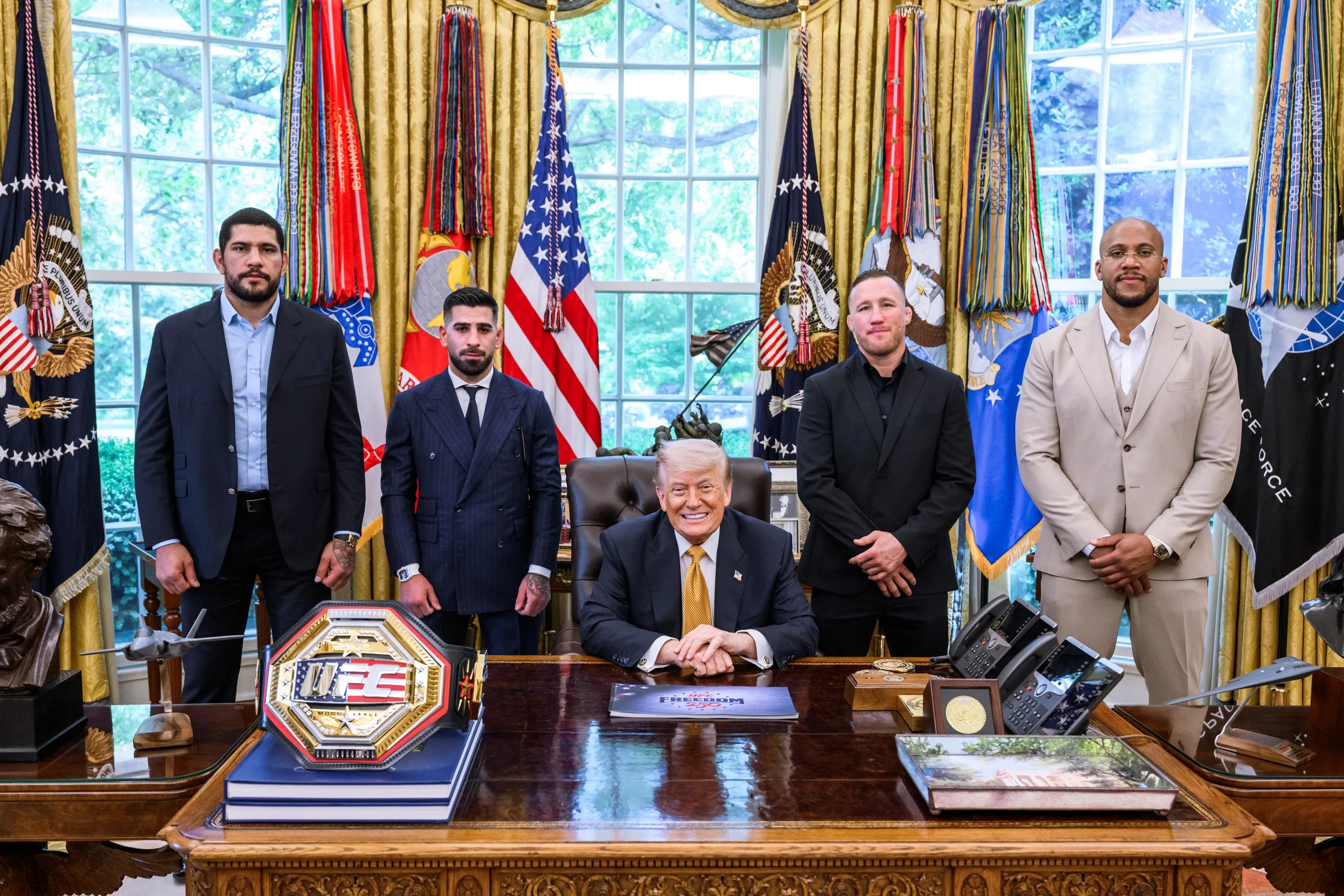
Then there is the fact that Campos specifically chose a UFC fighter as his shining example of nationalism. For those who have followed my reporting on combat sports over the years, you’ll know that the sport oozes nationalist machismo and has long been a vector for strongman politics. Topuria is no exception. He visited Donald Trump in the Oval Office and even headlined the UFC propaganda spectacle that took place on the south lawn of the White House. He actively participated in another president’s soft power display—a country that has threatened a trade embargo with Spain—yet that does not seem to bother Campos.
Topuria also faced domestic abuse allegations from his ex-wife in 2025. He denied the accusations and claimed he was being extorted. The case was dismissed after the former couple reached a settlement out of court. Somehow, Campos must have forgotten to mention these inconvenient details when making a case for Topuria as the ideal Spaniard.
“There are no nations of Yamals,” Campos concluded in his piece. “There are only the nations of Topurias.”
Here’s the thing: Yamal’s decision to pay homage to his family roots is not a rejection of the country he represents. It is a small, personal display of family pride and an example of the type of diversity that reflects Spain’s changing population. To demand that people trade their heritage for some outdated vision of nationalism is to reduce citizenship to an outdated ethnic purity test rather than a democratic society built on shared rights and values.
It’s a shame Campos still can’t understand that…unless Yamal scores, of course.
Sports Politika is a media platform dedicated to the intersection of sports, power and politics. If you like what you see, upgrade to a paid subscription (or gift a subscription if you already have your own). We would appreciate if you could also like the post and let us know what you think in the comment section below.
Fascists are such assholes
Mariachi culture and the movie Desperado are thoroughly Mexican, which is not the same country as Spain 🤔