

The Many Crypto Schemes of Khabib Nurmagomedov
As UFC champion, Khabib built a brand on humility, faith, and denouncing vices like gambling. His brand is now repeatedly deployed to legitimize volatile financial products and fans are noticing.

Welcome to Sports Politika, a media venture founded by investigative journalist and researcher Karim Zidan that strives to help you understand how sports and politics shape the world around us. Our mission is to offer an independent platform for accessible journalism that raises awareness and empowers understanding.
This latest post is written by Chris Dalby, the publisher of the Sport & Crime Briefing and World of Crime newsletters. If you enjoyed this in-depth investigation, please consider subscribing to read more of his work.
It took barely a day for an NFT drop, using the image of UFC legend Khabib Nurmagomedov, to make roughly $4.35 million in revenue.
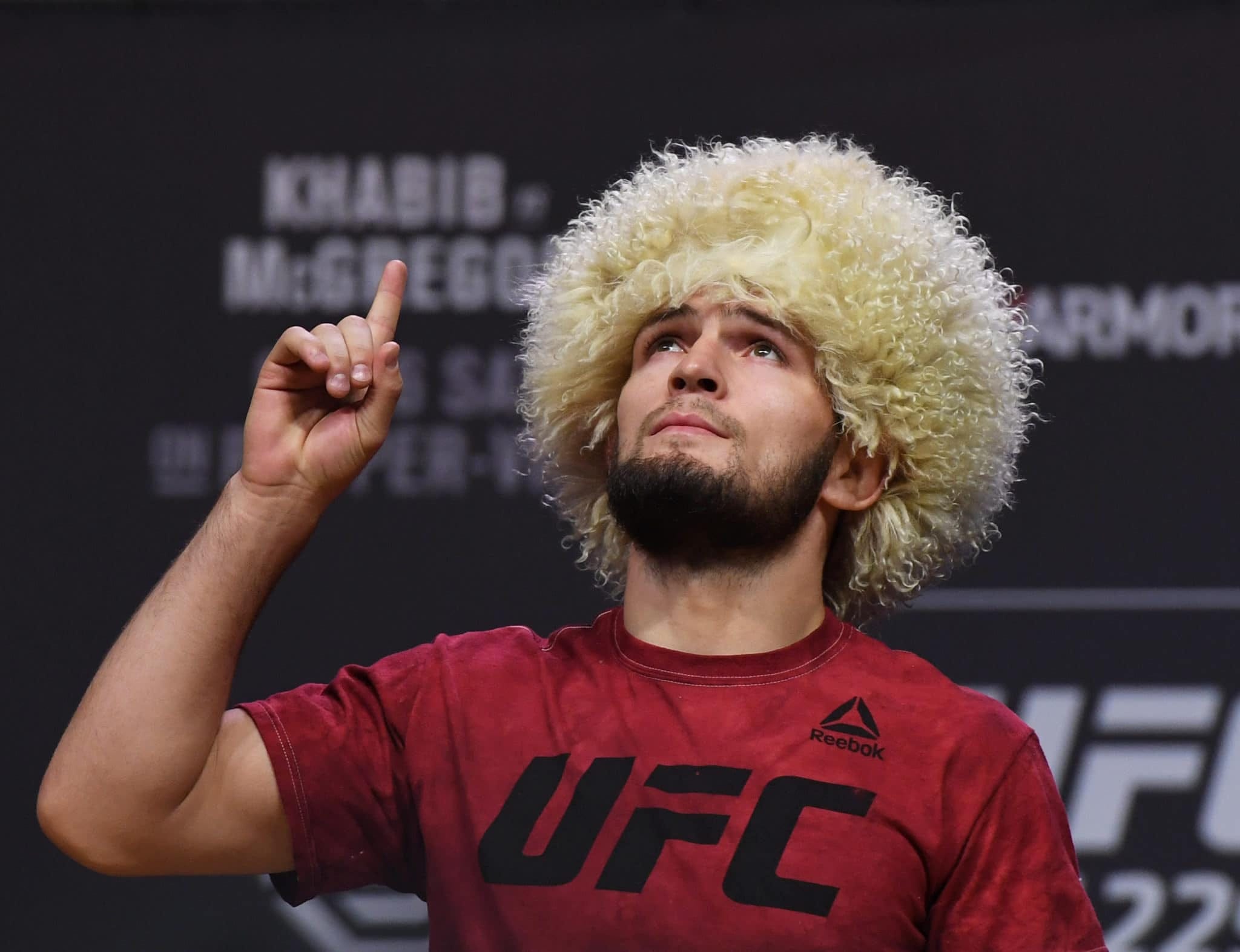
Over about 24 hours, messaging platform Telegram auctioned off 29,000 digital papakhas, the distinctive sheepskin hat that Khabib wore throughout his career. Controversy grew as the sale also involved Khabib saying it was in honour of his deceased father and coach, Abdulmanap, a devout Muslim who taught his son discipline and principles alongside martial arts.
Now, Abdulmanap’s legacy was being repackaged as a “digital gift” on Telegram, purchasable with Stars, a gamified in‑app currency.
Once the 29,000 hats were gone and the funds secured, Khabib’s announcement posts and promotional videos quietly vanished from Instagram and X, triggering accusations of a “sell‑and‑scrub” maneuver. Conor McGregor, the Irish fighter who is no stranger to crypto-controversies, lambasted Khabib for “robbing fans,” while Khabib defended the papakhas as “exclusive digital gifts with real‑time value” that honored Dagestani tradition.
The papakha drop was not a one‑off misjudgment. It was the latest example of a pattern that has been building since 2021. In the four years leading up to this sale, Khabib has repeatedly put his name behind a string of speculative crypto, NFT, and “halal” investment ventures that fall short of criminal fraud but seem suspiciously like calculated grifts.
Scheme 1: April 2021 - The Legacy Cards
1. How It Worked
Six months after retiring undefeated, Khabib launched his debut into the crypto-sphere. The pitch was elementary: artificially scarce goods based on his 29-0 fighting record. He released a tiered set of digital trading cards (NFTs) featuring 3D renderings of himself.
The structure was a pyramid of exclusivity:
Gold Cards: 290 units available.
Platinum Cards: 29 units available.
Diamond Card: Only 1 unit minted. Holders were promised vague “unlockable content” and the chance to win physical memorabilia, but the primary selling point was simply owning a piece of the “Eagle” on the blockchain before the market exploded.
2. The Profit
The pricing strategy was aggressive, targeting high-net-worth “whales” rather than the average fan.
Gold cards started at $2,900. Platinum cards were priced at $29,000. The single Diamond card was listed for $290,000.
The total haul is opaque. While reports at the time listed the Platinum cards as some of the “most expensive sports NFTs” on the market, the total quantity of sales remains unverified. The “burn” clause (destroying unsold cards to artificially boost value) was the failsafe; if they didn’t sell, they would be deleted to pretend demand was higher than it was.
3. The Backers
This was a maneuver by Dominance MMA, Khabib’s management firm led by Ali Abdelaziz. This launch served as a proof-of-concept: was Khabib’s fame and reputation enough to get fans to pay five or six figures for a digital file?
4. Why It Raised Concerns
This was the classic NFT trap. In 2021, fans could pay the price of a new car for a Platinum card. Today, that asset has virtually zero value. There is no secondary market for these cards; you cannot sell them because no one wants them. The “utility” (access, prizes) evaporated once the initial hype cycle died. The investors are left holding a “dead link” in their digital wallet, while the issuers collected the Ethereum upfront. It was a pure wealth transfer from the believer to the icon, with no residual value left behind.
Scheme 2: September 2021 – Wahed “Halal Investing” Partnership
1. How It Worked
Khabib’s longest‑running financial partnership is with Wahed Invest, an Islamic robo‑advisor he first signed on with in September 2021 as a global brand ambassador. Wahed’s core pitch is simple but powerful in Muslim‑majority markets: it offers Sharia‑screened portfolios in stocks, sukuk, gold and other assets, promising “halal, riba‑free (interest-free) investing” for people who want to grow their savings without touching interest, gambling, alcohol or other prohibited sectors. From the outset, Khabib wasn’t just another face on a banner. He fronted Wahed’s “Fighting Riba” content, sat for videos and podcasts about money and faith, and framed the platform as the answer to a problem he said he cared deeply about: how Muslims can invest without compromising their beliefs.
This deal is in a different category from his other ventures. Wahed is regulated, multi‑jurisdictional, and pitches itself as the ethical antidote to both conventional banking and casino‑style crypto. Over time, the campaign broadened beyond generic “invest halal” messaging. Khabib appeared in UAE launch materials, London‑branch pushes, and more recent “Everyday Shariah Account” spots, turning him into the primary human advertiser for a relatively new fintech brand that leans into “halal digital assets.”
2. The Profit
For Wahed, the partnership delivered exactly what it was designed to: trust and scale. The company grew into the hundreds of thousands of users across more than a dozen countries, with Khabib‑fronted ads and social content doing much of the work in markets where his word carries more weight than any regulator’s seal. Each new account, even if modest in size, feeds a fee‑based model where the platform earns a percentage of assets under management, and the halo of “Sharia‑compliant” plus “Khabib‑approved” lowers the psychological barrier for first‑time investors.
For users, the picture has been more mixed. Traditional equity and sukuk portfolios have behaved like any other conservative basket—up in good years, down in bad ones, with fees clipping performance at the margins. Where the controversy creeps in is at the edges: higher‑risk products, marketing that sometimes blurs the line between “safer because halal” and “safe in absolute terms,” and the implicit promise that, because Khabib and Sharia scholars are vouching for it, this is a morally superior and therefore less dangerous way to put money to work. When markets snap the other way, those assumptions meet the same reality as any other investment: balances can and do fall, and “halal” does not mean loss‑proof.
3. The Backers
Wahed is not an anonymous Telegram account; it is a U.S.-registered investment adviser with backing from institutional names and a physical footprint that now includes a flagship branch in London. That makes this scheme structurally different from CONVICT or a pump‑and‑dump: there are regulated entities, filings, Sharia boards, customer service desks, and an identifiable CEO who answers press questions. The firm has also been willing to push the boundaries of marketing to stand out in a crowded ethical‑finance field.
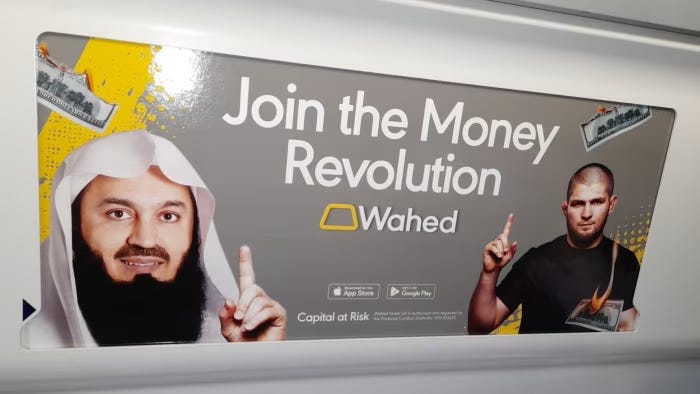
That pushiness has brought formal blowback. In 2022, Wahed agreed to a six‑figure SEC penalty over deficiencies in how it presented performance and client disclosures in the U.S. In early 2025, the UK’s Advertising Standards Authority banned one of its most high‑profile campaigns, posters on London’s transport network, featuring burning U.S. dollar notes and Khabib himself, to “provoke” viewers into thinking conventional money was literally being torched. Regulators deemed the ads misleading and socially irresponsible; Wahed publicly defended the campaign as necessary provocation but ultimately had to pull it.
4. Why It Raised Concerns
On paper, the Wahed partnership aligns with the values Khabib articulated during his career: no gambling, no usury, no alcohol money. In practice, the combination of religious branding and formal rebukes makes it seem like “halal” has become another marketing hook.
Online Islamic‑finance communities have flagged red flags: aggressive advertising, operational glitches, and a sense that some customers did not fully grasp the risks they were taking on precisely because they trusted the Sharia label and Khabib’s involvement.
There is no evidence that Wahed is a rug pull or that Khabib is secretly siphoning money from his followers through it. The platform exists, the portfolios are real, and many users are satisfied. The controversy lies elsewhere: in the way his moral authority is repeatedly mobilised to sell complex, sometimes volatile financial products to people who may conflate “permissible under Islamic law” with “prudent for my savings.”
In that sense, the Wahed deal is the most uncomfortable of all.
Scheme 3: October 2021 – GoMining Ambassador
1. How It Worked
In late 2021, Khabib signed on as a global ambassador for GoMining, a remote Bitcoin‑mining platform that promised small investors a share of industrial‑scale mining profits without buying hardware or paying electricity bills. The sales pitch was that GoMining would handle all the messy, technical parts of running mining farms; fans just had to buy into the tokenized system and watch their balance go up.
Khabib’s role was to stand between a technically difficult product and a non‑technical audience, reassuring them that this complex mining scheme was safe and legitimate because he was “part of the team.”
Then, in 2023, the partnership evolved into a direct product offering: the “Khabib NFT Collection.”
The Pitch: These digital collectibles were allegedly backed by actual computing power.
The Claim: Users were told that holding this NFT was equivalent to owning a digital slice of a Bitcoin data center. This ownership would supposedly entitle them to daily Bitcoin rewards and entry into an exclusive club of holders.
The Method: This approach turned the complex process of running mining farms into a simple “clicker game” or a collectible item for fans.
2. The Profit
The financial mechanics of the partnership were designed to generate immediate, upfront profit for the backers and the ambassador, while placing the long-term risk entirely on the fans. GoMining banked on gaining an instant credibility upgrade in MMA‑obsessed markets. They earned upfront revenue by selling the NFTs during a difficult market.
Then, in early 2023, Khabib launched a branded GoMining NFT collection, each token supposedly “backed” by a fixed slice of Bitcoin mining power. The hook this time was more explicit: don’t just own a picture of Khabib—own an NFT that mines bitcoin for you. Buyers were told that holding one of these cards would entitle them to a daily payout of BTC, turning Khabib’s image into a synthetic mining rig on the blockchain. Exclusive “club” rhetoric and access perks were layered in, but the core promise was passive income anchored to his name.
3. The Backers
GoMining maintains limited transparency about its operations, with offices in Cyprus and the British Virgin Islands. For them, Khabib was the ideal on‑ramp: a devout, “no‑nonsense” champion whose brand screamed reliability in regions where regulators and consumer watchdogs are weak. The partnership slotted neatly into a pattern that others would later later repeat with the former UFC champion.
4. Why It Raised Concerns
Mining bitcoin and selling NFTs is not illegal. The trick is in how risk and reality are framed.
Retail buyers were sold exposure to “Khabib-backed” mining without any meaningful visibility. They could not audit where the physical machines were, what the true energy costs were, or how their share of profits was calculated.
By selling “mining power” as an NFT, the company decoupled the asset from the actual hardware. The user bought a digital receipt for a machine they will never see, controlled by a company they cannot audit.
The controversy lies in the fact that Khabib never had to explain the realities of Bitcoin mining, such as why most retail mining schemes underperform simply buying and holding Bitcoin. If the token value collapsed or the mining yield stagnated, the economic pain remained with the fans who had trusted his face.
If GoMining ckloses or changes the terms of service, the NFT instantly becomes a a worthess digital receipt for a service that no longer exists.
But despite these risks, GoMining is still active. It reports having sold hundreds of thousands of digital miners and millions of dollars’ worth of Bitcoin earned by holders.

Scheme 4: October 2024 - Ice Open Network (ION) Global Ambassador
1. The Scheme
In October 2024, Khabib joined Ice Open Network (ION) as Global Ambassador. ION is a blockchain startup that runs a mobile app where users can earn cryptocurrency by tapping their phone daily.
The pitch was simple: Users could “mine” ICE tokens by simply logging in daily, tapping a button, and inviting friends. Again, there was no expensive hardware, no technical knowledge required. Positioned as a gateway to crypto for the masses, the app claimed to have onboarded 20 million users by the time Khabib signed on.
The announcement was managed through official ION channels, featuring promo reels and Khabib’s statement about believing in the technology’s mission of user empowerment and data ownership.
The tap‑to‑mine model, however, raised real questions. Users weren’t solving cryptographic puzzles like Bitcoin miners. They were pressing a button daily, watching ads, and building referral networks. The core mechanic was engagement‑driven: rewards increased through social recruiting and consistent app usage.
2. The Profit
Controversy surrounding ICE’s scheme started months before Khabib joined as ambassador. In January and February 2024, ION introduced mandatory quizzes and identity verification requirements. Users had to pass a 21-question test about the project and submit government ID to prove they weren’t bots.
While these steps are standard, reviews on Trustpilot from the time see users claim that failing the quiz or not uploading the ID allegedly saw accounts locked and mined coins automatically deducted.
Eight months after this crisis, Khabib joined as Global Ambassador during Binance Blockchain Week in Dubai. Since then, he has continued to appear at ION events and to promote their new products.
So did users stand to make money? Yes, and reviews from TrustPilot became a lot more positive around the time Khabib joined. But ION only allowed a minority of tokens to be mined in this way. 28% of tokens were reserved for user “mining”, 25% went to the founding team, and 15% went to governance, according to their own documentation.
But even so, the model appeared cost‑free on the surface. The “cost” was time, attention, and data as users consented to data collection and ad viewing as part of the experience. Whether this represented a fair exchange or a structural disadvantage depends on the eventual utility of ICE tokens and the project’s long‑term viability.
3. The Backers
ION was founded by Alex Iulian and a Dubai‑based team. The project positioned itself as an emergent chain competing for attention in a brutal Layer‑1 market. The team has not attracted any major controversy to date, beyond the ones laid out above.
In January 2025, ION stopped the tap-to-mine mobile app and shifted all focus to building their “mainnet”, a full blockchain network. Since then, the token price has cratered, lowering the value of said tokens.
4. Why It Raised Concerns
Of all the crypto-endorsements on this list, Khabib’s endorsement of ION seems the most legitimate. There’s no proof ION’s founders planned to defraud users from the start. The verification system, while harsh, had a legitimate purpose, and the cratering of the tokens was due to the vulnerability of any coin.
Still, seeing Khabib endorse ION after famously refusing to take gambling sponsors during his fighting career was odd.
Scheme 5: November 2024 – A Jab at Conor McGregor
1. How It Worked
This may be the most bizarre attempt on this list. In late 2024, Khabib stepped into full meme‑coin territory by publicly backing CONVICT, a token riffing on Conor McGregor being found liable for sexual assault at a Dublin civil court.
The pitch was pure internet theatre: a satirical coin claiming to be raising money for McGregor’s victims. There was obviously neither a white paper nor a business model. There was just a ticker symbol, a jokey narrative, and Khabib’s post declaring his “support”, which just really looked like another jab at his hated rival.
Khabib wasn’t even connected officially with CONVICT, as far as we know. His manager, Ali Abdelaziz, frequently posts from Nurmagomedov’s account, raising questions about whether Khabib himself made the decision or whether his camp orchestrated it.
2. The Profit
For low-liquidity coins like this, a single celebrity tweet can cause an exponential price spike. For whoever deployed CONVICT, Khabib’s nod was a jackpot. That flow alone was enough to send the price vertical, providing perfect exit liquidity for insiders who had quietly accumulated large allocations at near‑zero cost.
But for the buyers, the endorsement was the “Pump” and the inevitable reality was the “Dump.” When the momentum stalled, the price crashed, leaving retail fans holding bags of effectively worthless tokens while the deployers had already cashed out.
3. The Backers
CONVICT was not fronted by a recognizable company. This anonymity is crucial to the scheme: there was no entity to hold accountable, only Khabib’s face to point to when things went wrong.
The true financial beneficiaries remain unknowable. All transactions trace back to anonymous Solana wallets. It followed the standard anonymous‑dev meme‑coin blueprint: cheap deployment, thin liquidity, and social‑media‑driven discovery. This was a “wildcat” strike, with online chatter speculating it could have been arranged, with Khabib’s knowledge, a quick payout given in exchange for a well-timed tweet.
4. Why It Raises Concerns
Launching a meme coin is not inherently illegal. The concern is in how risk and reality are framed.
Retail buyers were sold a narrative of “justice” wrapped in Khabib’s endorsement without being told they were stepping into a thinly traded pool where a handful of wallets could nuke the price in a single transaction. By promoting such a volatile asset to a mainstream audience, Khabib was not taking any risk himself and was not explaining the risk to his fans.
There is no public evidence that Khabib was paid for his endorsement. But the tweet got over 12,000 likes. And when the token’s value collapsed, the economic pain remained entirely with those who trusted the endorsement.
Scheme 6: October 2025 – MultiBank Group Partnership
1. The Scheme
In late October 2025, Khabib unveiled a sweeping partnership with MultiBank Group, a Dubai-based financial conglomerate, built around a new joint venture called MultiBank Khabib LLC and a token called $MBG.
The promise was grand: a “regulated” tokenized sports ecosystem where $MBG would power a network of Khabib-branded ventures. The most visible plan was to build 30 high-end gyms carrying his name.
This branding was clear to fans and retail buyers. This wasn’t a meme coin; it was a regulated bridge between real-world assets and crypto, with an undefeated champion standing alongside a global broker.
This time, Khabib was not just a spokesman but a named partner through MultiBank Khabib LLC, implying equity, revenue‑sharing, and insider token allocations ahead of most retail buyers.
2. The Profit
The $MBG token went on sale months earlier. It began with a pre‑sale in mid‑July 2025 at $0.35, and then ran up to a reported all‑time high near $2.45 in August, before sliding hard by October.
Khabib entered the picture in late October after the peak and while the token was already unwinding. It means he didn’t cause the initial run-up, nor could he be credited for the early windfalls. Instead, his presence gave the project institutional sheen just as the price waned.
This means that MultiBank still benefited from his reach, their token had a flagship star, and the venture could selling a specific vision. But over a month after the announcement, the $MBG token price hasn’t climbed at all.
3. The Backers
The backer here is a well-known entity, MultiBank Group, founded by Naser Taher and operating out of Dubai with a long list of licenses and regulatory claims. Its branding is all about differentiating itself from the junkyard of meme coins and failed efforts. However, a lot of questions remain about how this sports empire, backed by MultiBank Group, will actually work.
The deal structure granted MultiBank exclusive rights to develop and promote projects under Khabib’s brands and put $MBG at the center as the supposed “backbone” that would someday run access, rewards, and participation across these assets. It reads a bit like a sports‑meets‑finance moonshot.
4. Why It Raised Concerns
MultiBank Group is a real broker, the token is real, and the joint venture was announced in the open. But that initial transparency means the risk was easy to miss.
The $MBG model sells tomorrow’s assets using today’s token. The gym sare projected, the revival of Khabib’s Eagle FC MMA promotion is projected, the value for token holders is projected.
A lot remains to be answered. What gyms are being funded? Are they under construction? What revenue streams will exist? How will these revenue steams flow to $MBG token holders? Because the buyers are not purchasing shares or stakes in real buildings.
The timeline of $MBG’s performance adds to the concern. Its value ran up before Khabib arrived, cratered, and has remained flat since he joined up.
Scheme 7: November 2025 – The Papakha NFT Auction
1. The Scheme
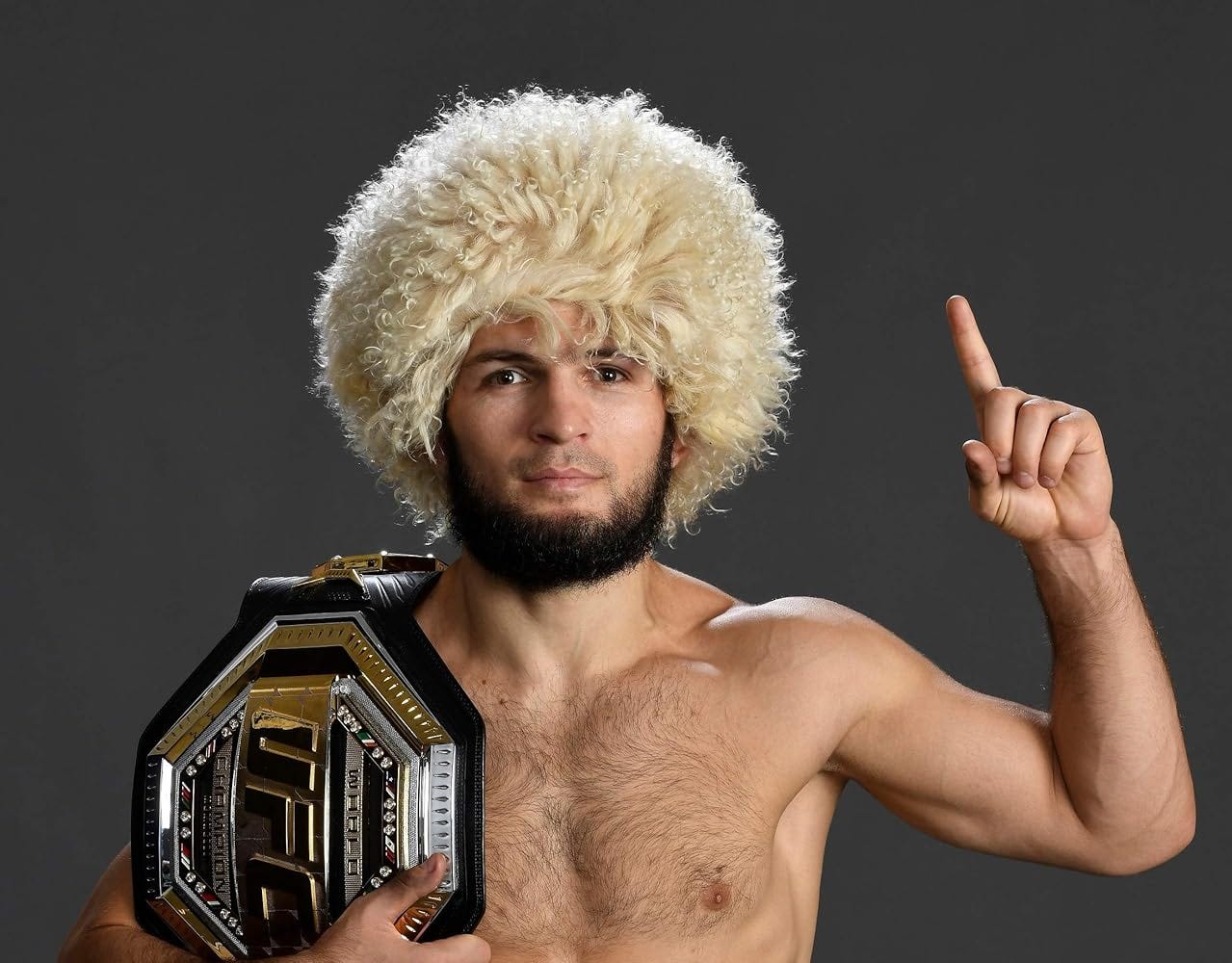
On November 22, 2025, Khabib launched a 24‑hour auction of 29,000 digital papakhas, cartoonish representations of the traditional Avar sheepskin hat he wore throughout his career, through Telegram’s in‑app marketplace.
The emotional hook was clear: this was presented not as another NFT but as a way to hold a piece of Khabib’s and his late father Abdulmanap’s legacy. The marketing explicitly leaned on family and faith. In promotional materials, Khabib stated: “My father passed this down to me. Now, I want to pass this down to you.”
The sale structure saw 290 bidding rounds, each lasting five minutes, with 100 items allocated per round to the highest 100 bids. The bids were made in Telegram Stars, an in‑app currency convertible to Toncoin or real-world currency. The scheme brought in around $4.35 million in just under 25 hours.
Telegram took a platform fee, its in-app currency gained in visibility, as did the associated TON coin, and Khabib pocketed a major payday for lending his image and his father’s story to the campaign.
Unlike earlier schemes, there was no yield promise or roadmap. Once the sale was finished, the job was done.
3. The Backers
This operation leveraged the infrastructure of Telegram and Pavel Durov’s TON Network, two Russian‑origin tech platforms operating from Dubai-based account, in alignment with a Dagestani celebrity.
This is not the first such scheme on Telegram. Limited Telegram gift collections (like Durov’s Caps and Plush Pepes) have seen floor prices in the tens of thousands of TON, with individual Pepes selling for $150,000 equivalent.
But this was the most visible example fo this scheme, tapping into Khabib’s global fandom and his unique cultural heritage.
4. Why It Raised Concerns
Technically, buyers got what they paid for: a tokenized collectible of a hat in their Telegram account, tradable as as an NFT.
The grift lies in how the product was framed and then scrubbed. Once the sale concluded and criticism mounted, Khabib’s promotional posts and videos quietly disappeared from Instagram and X. This “sell‑and‑scrub” pattern triggered accusations from McGregor, who accused Khabib of scamming fans and exploiting his late father’s memory for profit.
Khabib responded by dismissing McGregor as an “absolute liar” and emphasizing the project’s genuine intent as a cultural keepsake rather than a profit‑driven scheme.
But Khabib and his partners did not emphasize that these items had no guaranteed resale value, no protection from price collapse, no utility beyond status display. Instead, they framed it as being about family, faith, and culture.
So where’s the crime?
Khabib is not the first retired star to drift into crypto, but the volume and character of these deals make his case unusually contentious. Across four years, the pattern repeats: his name and moral authority are attached to high‑risk, thinly regulated products that promise access, yield, or cultural closeness, while the economic risk sits almost entirely with fans and small investors.
There doesn’t appear to be much of a selection process. Khabib’s photo and name have been plastered onto NFTs, tap‑to‑earn apps, meme coins, and tokenised empires.
None of this, on its face, amounts to criminal fraud. The companies exist, the tokens function, the NFTs are delivered, and in several cases the underlying projects are still operating.
And, true, these exact criticisms have been levied at NFTs since their inception and those gullible enough to buy the digital papashkas only have themselves to blame.
But Khabib has become very good at convincing his fans to part with their cash.
Sports Politika is a media platform focusing on intersection of sports, power and politics. Support independent journalism by upgrading to a paid subscription ( or gift a subscription if you already have your own). We would appreciate if you could also like the post and let us know what you think in the comment section below.
 | A guest post by
|
Who keeps buying this slop?! I do not understand why people keep falling for these grifts.