

"In my country, I suffer injustice"
In Morocco, football has emerged as a battleground between political aspirations and popular dreams.

Welcome to Sports Politika, a media venture founded by investigative journalist and researcher Karim Zidan that strives to help you understand how sports and politics shape the world around us. My mission is to offer an independent platform for accessible journalism that raises awareness and empowers understanding.
If you share this vision, please consider supporting my work by becoming a paid subscriber.
“This great dream and this great ambition will have to wait,” opined writer Abdelkader El-Aine following Senegal’s dramatic 1-0 victory over Morocco in the final of the 2025 African Cup of Nations (AFCON).
The match itself was extraordinary, ranking among the greatest ever seen on the African continent. Remarkably, the chaos was confined to the closing moments. Senegal had a goal disallowed in stoppage time, and minutes later Morocco were awarded a penalty. This prompted Senegal’s players to walk off the pitch in what appeared to be a forfeit.
After a long, dramatic delay—during which Senegalese fans invaded the pitch and clashed with Moroccan security—Brahim Díaz missed a poorly executed Panenka, sending the match into extra time. Pape Gueye then scored the decisive goal in the 94th minute, extending Morocco’s 50-year AFCON title drought and turning Rabat’s dreams of glory into the stuff of nightmares.
And despite several days having passed for tensions to cool, there is little indication that Morocco intends to let the incident die down anytime soon.
In a strongly worded statement, the Royal Moroccan Football Federation said it would seek redress from both the Confederation of African Football (CAF) and FIFA. “The Royal Moroccan Football Federation announces that it will pursue legal action with the Confederation of African Football and Fifa to rule on the walk-off of the Senegalese national team from the field during the final against the Moroccan national team, as well as on the events surrounding this decision, following the referee’s awarding of a penalty that was deemed correct by all experts,” the statement said.
“This situation had a significant impact on the normal course of the match and on the players’ performance,” it added, reflecting a belief within the Moroccan camp that the lengthy delay contributed to Díaz’s miss by unsettling him at a crucial moment.”
CAF has also condemned the walk-off, describing Senegal’s actions as “unacceptable” and “inappropriate”, and confirming that it would be “reviewing all footage and will refer the matter to competent bodies for appropriate action to be taken against those found guilty”.
Nevertheless, there is little that Morocco can do to rewrite history. Despite investing billions to transform the African kingdom into a football powerhouse, sometimes at the expense of its own population, Morocco has little to show for its efforts.
This extends beyond sports and the prestige of winning football tournaments. Since Morocco’s unexpected fourth-place finish at the 2022 World Cup in Qatar, football has played a pivotal role in the country’s soft power strategy. Months later, Morocco was awarded co-hosting rights for the 2030 World Cup alongside Spain and Portugal—a diplomatic boon that has tilted public policy has tilted toward a single, obsessive goal: turning Morocco’s major cities into luxurious playgrounds for the global guests who will descend upon the country for a single month in 2030.
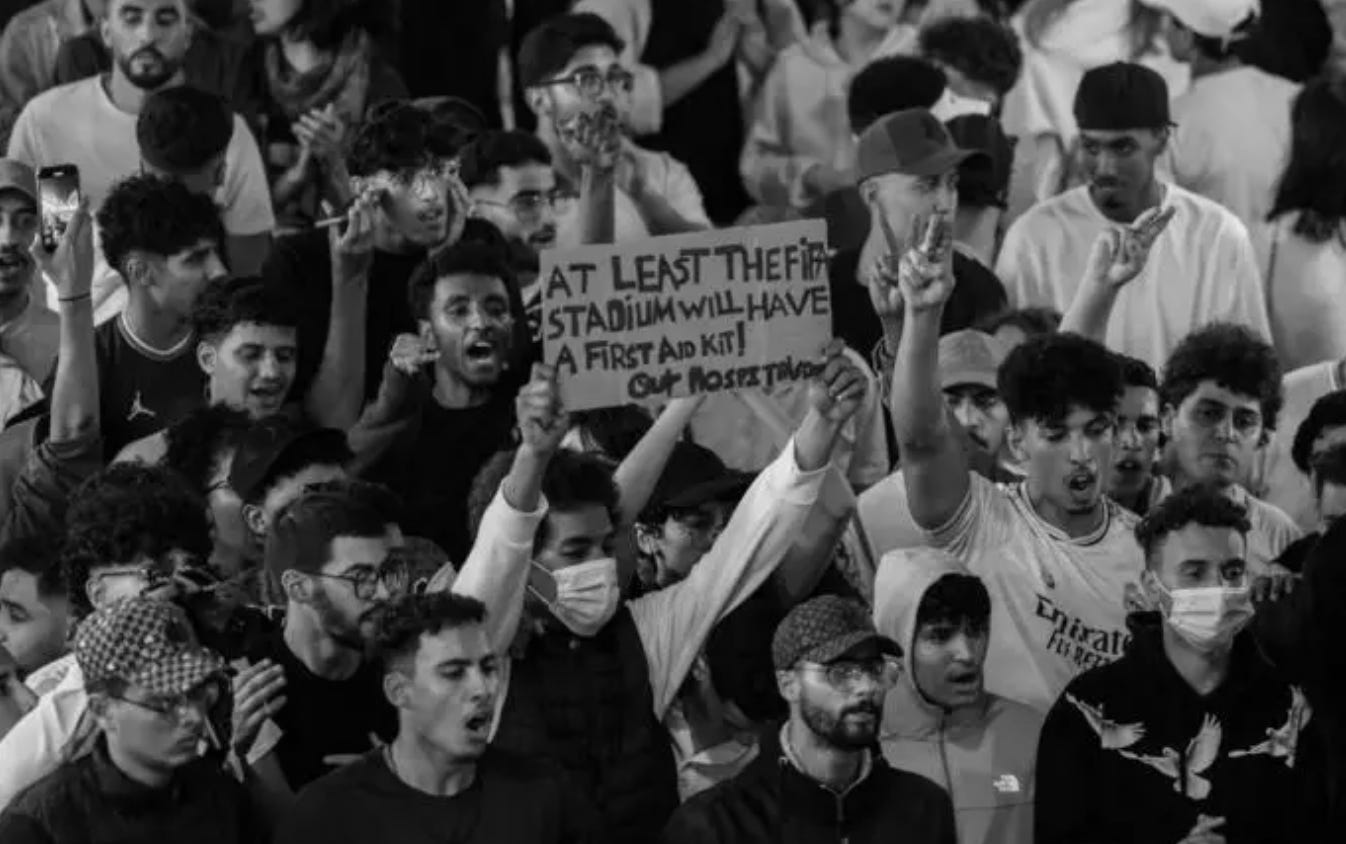
Billions of dollars are being poured into infrastructure, stadiums and urban makeovers. This obsession reached a tipping point following the death of eight women in a maternity hospital in Agadir in late September 2025. The incident sparked widespread youth-led protests demanding better healthcare and public infrastructure. Demonstrators criticized the government’s spending on sparkling football stadiums at the expense of hospital funding.
By late October, approximately 1,500 protestors—including several minors—were still behind bars awaiting trial on charges familiar to dissidents from any authoritarian regime: armed rebellion, incitement to commit felonies, and incitement against the state. At the same time, King Mohammed VI approved increased budgets for healthcare and education, as well as a new fund to support young candidates in upcoming elections—a sign that the kingdom was listening to its young critics.
Unlike many of its North African neighbours, Morocco maintains nominally free and fair elections, though its government is centred around the monarchy and palace-aligned elites, usually termed al-makhzen. Many youths aged 16–30 feel particularly disenfranchised in this authoritarian system and view political parties and state institutions as averse to their engagement and interests.
In the wake of the 2011–2012 popular uprisings, the makhzen bolstered repressive measures, curbing protests and online activism and constricting outlets for citizens to vent frustrations. Two years of strict Covid lockdowns further limited educational and job prospects, leaving the country’s youth reeling.
As was the case in Egypt, Morocco’s youth took to chanting slogans at football game. Stadiums were among the few places free of state control, where citizens could air grievances in hoarse, passionate cries.
The first ultras to emerge on the scene in Morocco were the “Green Boys,” who arose around the football club Raja Casablanca in 2005. Raja CA was founded by the Moroccan resistance to French colonial rule in 1949, including the first president of the Moroccan Workers’ Union and ex-prime minister Mohamed Maâti Bouabid.
Apart from chanting slogans and intimidating rivals, the Green Boys pivoted to politics and activism. They launched a drive to make stadiums safer for women following national media attention on sexual violence at football matches in 2018. They also shouted at police overseeing the match and booed the national anthem, with their most famous chant being “Fbladi Delmouni,” which translates to “I was wronged in my country” or “In my country, I suffer injustice.”
“Fbladi Delmouni” has become a cultural phenomenon since it was first sung in 2017, gradually morphing into a rallying cry of an entire generation of Moroccans fed up with the lack of opportunities in their country. Some of the clips of the chant have accumulated more than 11 million views on YouTube.
Here is a complete translation of the song:
Oh oh oh oh
I was wronged in my own country
Oh oh oh oh
To whom shall I raise my grievance?
Oh oh oh oh
To the Lord Almighty
Oh oh oh oh
He, the only one who knows my sufferings
We live a miserable life in this country
We are seeking peace
Oh, our Lord, make us victorious
They killed us with drugs
And left us like orphans
We will seek revenge on Judgement Day
You wasted our youth’s talents
And you destroyed them with drugs
As you always wanted it to be.
You sold our country’s wealth
And gave it to foreigners
You repressed a whole generation
Oh oh oh oh
You killed the passion
Oh oh oh oh
You started the provocation
Oh oh oh oh
You killed the passion
Oh oh oh oh
You started the provocation
No one feared what you invented,
What you used on us
You just wanted to rule us
For a flare you sentenced us with Huis Clos, 1
You banned the Tifo
You waged a war against the Ultras
You accused us of inciting riots
You forgot how much you applauded us
Now you reward us with months in prison
You’ve ruined the Rajaouis’ lives,
Their jobs and their studies
Because you didn’t understand the meaning of passion
Oh oh oh oh
I’m sorry, my family
Oh oh oh oh
The talk about me has become too much
Oh oh oh oh
It’s getting on my nerves
Oh oh oh oh
Just understand me already
Every day the same speech
At home or in the streets:
“What did Raja give to you?”
“You lost your whole life for it.”
“So much money spent on it.”
“And never abandoned it.”
My dear ones, just understand me
Why do you want to separate me
From Raja which consoles me?
This is my final word
Written from my heart
With tears in my eyes
Oh oh oh oh
Repentance belongs to the Almighty
Oh oh oh oh
Our Lord, accept our repentance
Football clearly occupies a central place in Moroccan society, culture, and politics. At the same time, the government’s new wave of investments suggests an effort to harness the sport as a form of soft power on the world stage, drawing on the global prestige and brand value associated with hosting the world’s biggest sporting event.
It is also an opportunity to exert pressure on occupied territories. Morocco is tied in a long-standing dispute with the Western Sahara, a desert territory annexed by Morocco following Spain’s colonial departure in 1975. The Sahrawi people, an indigenous group native to the region, continue to seek independence, which Morocco vehemently refuses. Morocco administers about 80% of the disputed territory, including resource-rich areas with phosphates and fisheries. Morocco also has a deteriorating relationship with neighbour Algeria, with the latter claiming that Morocco was mining for phosphate on land belonging to Algeria.
However, by closely linking its national passion for football with broader political ambitions, Morocco has invited criticism domestically and internationally.
The Royal Palace has been quick to respond to the AFCON fallout. Prince Moulay Rachid received the members of the national football team at the Royal Guests Palace in Rabat, where they posed for a commemorative photo.
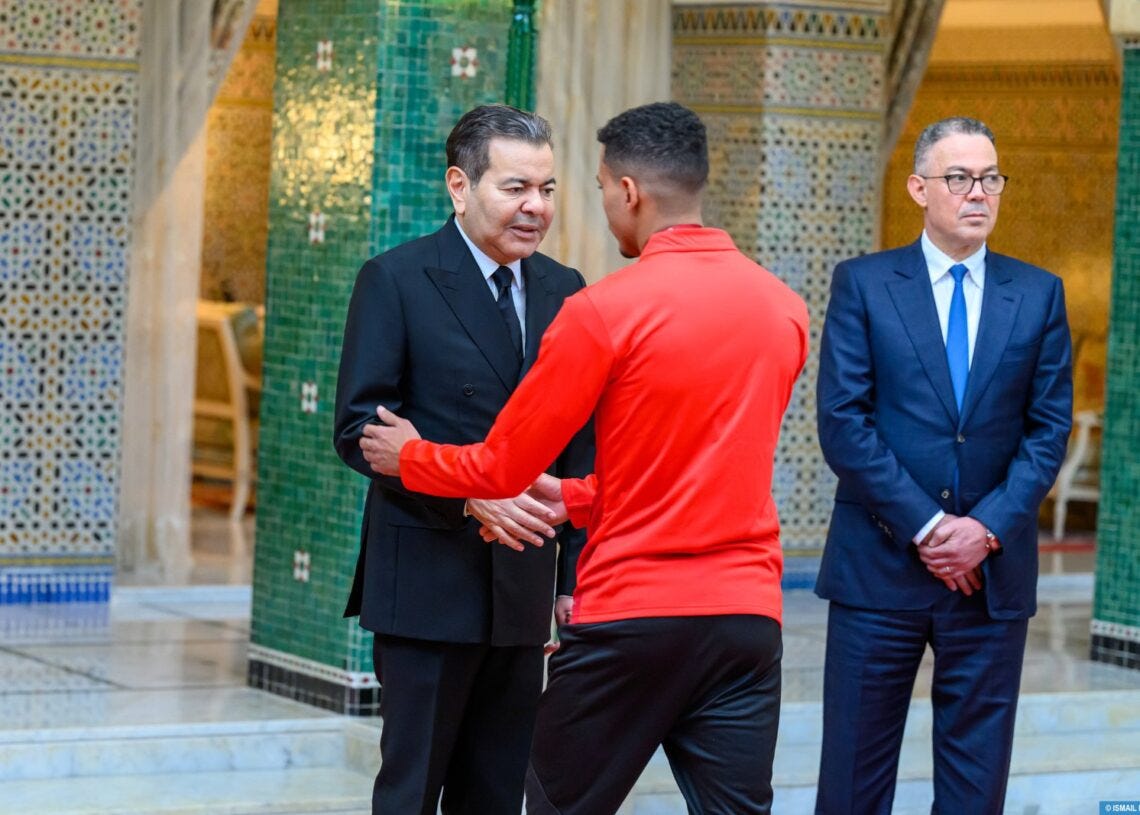
King Mohammed VI, meanwhile, also offered words of support to the team and the nation following the defeat to Senegal, emphasizing that the team has “shown the world an example of what Moroccan and African youth can accomplish when they have confidence in their talents and capabilities.”
“You have also proven, by the determination and heroic and honorable performance you displayed, the importance of our strategic vision to invest in human capital and modernize the Kingdom’s infrastructures, which demonstrated their resilience and world-class level of readiness in anticipation of hosting the 2030 World Cup,” the King said in His message.
Sports Politika is a media platform focusing on intersection of sports, power and politics. Support independent journalism by upgrading to a paid subscription ( or gift a subscription if you already have your own). We would appreciate if you could also like the post and let us know what you think in the comment section below.
Thank you for broadening my horizons. I never heard of this until now. Also that song is so poignant.