

How Morocco Turned Football Into a Tool of Statecraft
The kingdom’s World Cup ambitions stretch far beyond the pitch, intertwining football with diplomacy, domestic politics and the contested future of Western Sahara.

Welcome to Sports Politika, a media venture founded by award-winning investigative journalist Karim Zidan that strives to help you understand how sports and politics shape the world around us. My mission is to offer an independent platform for accessible journalism that raises awareness and empowers understanding.
If you share this vision, please consider supporting my work by joining becoming a paid subscriber or by pre-ordering my new book, THE ULTIMATE STRONGMEN.
As the football world turned its attention to New Jersey’s MetLife Stadium for the 2026 World Cup final, Morocco was in the midst of an increasingly tense diplomatic dispute over who will host the next World Cup final.
The kingdom is cohosting the 2030 tournament alongside Spain and Portugal, but FIFA has yet to decide where the final will be played. Spain insists the showpiece belongs on Spanish soil. Morocco, however, is betting that a new 115,000-seat stadium outside Casablanca can convince FIFA otherwise.
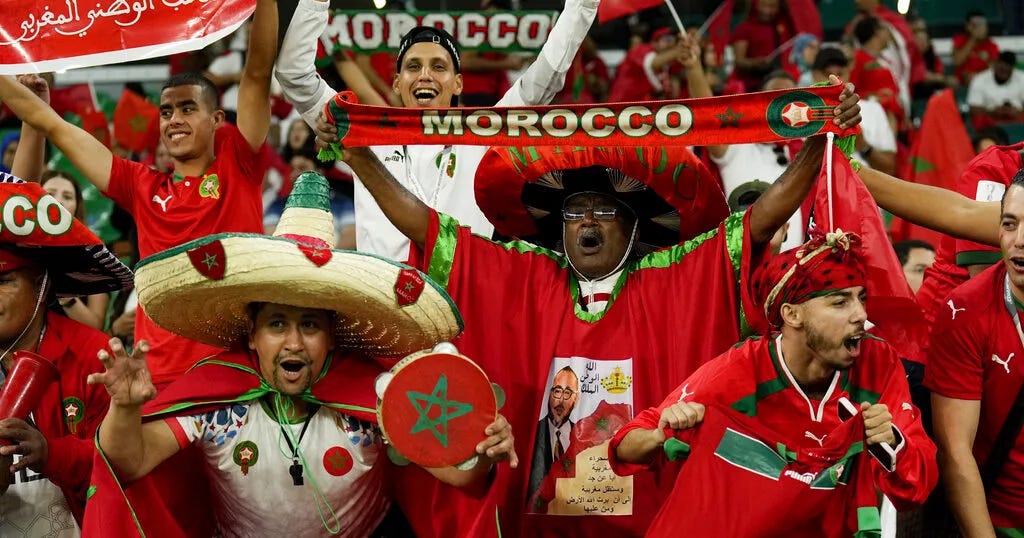
That Morocco is even competing to host football’s biggest match reflects how deeply the sport has become woven into the kingdom and has rapidly accelerated its investment in the sport. Since its historic run to the 2022 World Cup semifinals – the first by an African or Arab nation – Morocco has transformed football into a national project.
After securing cohosting rights for the 2030 World Cup, King Mohammed VI’s government accelerated investment in transport, airports, urban development and sporting infrastructure.
Alongside a new national stadium, Morocco has expanded elite training facilities, invested in youth development and intensified its recruitment of diaspora talent across Europe in search of its next generation of international stars.
The strategy is working. Nineteen of the 26 footballers in Morocco’s most recent World Cup squad were born outside the country; six of them were also eligible to play for France, while others were born in Spain, Belgium and the Netherlands. Morocco even attempted to recruit prospects like Spain and Barcelona FC star Lamine Yamal, whose father is Moroccan.
But Morocco’s football-first strategy has also raised uncomfortable questions about government spending, political priorities and the image the kingdom hopes to project ahead of 2030.
Morocco followed up its historic 2022 World Cup run by reaching the final of the 2026 Africa Cup of Nations (AFCON) on home soil before advancing to the quarter finals of the 2026 World Cup, becoming the first African nation to reach back-to-back World Cup quarter finals. The country’s success has extended beyond the men’s team, with Morocco reaching the 2024 Women’s AFCON final.
“I’d be surprised if Morocco isn’t the dominant football nation in Africa over the next decade,” Jonathan Wilson, a football journalist, historian and author of The Power and the Glory: The History of the World Cup, tells WIRED Middle East. “You have good young players coming out of the European academies, you have excellent stadiums for them to play in, investment in the league, investment in women’s football, which, particularly in Africa, is not common. All of that seems to me hugely positive from a football point of view.”
“Whether that’s the best use of the country’s resources is a different question.”
The Cost of the Beautiful Game
Not everyone in Morocco agrees. In September 2025 – a few weeks before Morocco beat Argentina to win the Under-20 World Cup – young Moroccans took to the streets to protest a mounting health crisis sparked by the death of eight women in a maternity ward in the southern city of Agadir. Led by Gen Z Moroccans, the demonstrators demanded better health care and public infrastructure while denouncing the government’s lavish spending on gleaming football stadiums instead of hospitals with slogans such as: “No World Cup, health comes first” and “We want hospitals not football stadiums”.
“Grounding your development strategy in a sports mega event like the World Cup is a risky approach,” Dr Jules Boykoff, a former professional football player, political scientist and author of the recently published Red Card: The 2026 World Cup, Sportswashing, and the FIFA Greed Machine, tells WIRED Middle East.
“Generally, economic development in the service of a sports mega event tends to go awry. The strategy is especially risky in light of the fact that protestors have already taken to the streets to challenge the government spending priorities on football over the basic needs of the general population.”
Unlike many of its North African and Arab neighbours, Morocco maintains nominally free and fair elections, though its government is centred around the monarchy and palace-aligned elites, known as the makhzen.
Many youths aged 16-30 feel particularly disenfranchised in this authoritarian system and view political parties and state institutions as averse to their engagement and interests. In the wake of the popular uprisings in 2011-2012, the makhzen curbed protests and online activism while doing little to improve prospects.
Matters steadily worsened over the following decade, driven by crises such as the Covid-19 pandemic, which battered Morocco’s economy and left much of its young population struggling. As the country turned its attention (and money) to football, many of its long-standing social and economic problems resurfaced.
Three protestors were killed during the demonstrations in 2025, while dozens were injured in clashes with the police. More than 2,400 were arrested and faced charges in connection to the protests. At the same time, King Mohammed VI vowed to introduce social reforms and to increase spending on health care and education.
Nevertheless, Morocco continues to crack down on dissent within its borders. During the 2026 World Cup, authorities arrested Moroccan rapper and filmmaker Mehdi El Youbi – better known by his stage name Mehdi Black Wind – one of the most politically engaged artists in the country. His arrest came a day after the arrest of Moroccan journalist Ali Lmrabet.
Football Beyond the Pitch
Morocco’’s official human rights framework for the 2030 World Cup states that its independent human rights committee and the Royal Moroccan Football Federation will “encourage both the parliament and the government to ratify key international conventions”, while “upholding and promoting internationally recognized human rights standards”.
However, activists argue the framework overlooks long-standing concerns, including discrimination on the basis of sexual orientation and Morocco’s continued control of most of Western Sahara. At the time of publication, the Royal Moroccan Football Federation had not responded to WIRED Middle East’s request for comment.
Sahrawis, the indigenous ethnic group of the Western Sahara region, control the rest of the territory in the form of the Sahrawi Arab Democratic Republic (SADR).
For Morocco, Western Sahara is a pivotal part of its kingdom – an area deeply tied to national sovereignty and regional dominance. The occupied territory is rich in natural resources, and has an extensive Atlantic coastline, which expands Morocco’s borders and trading options.
“I think one important thing to keep in mind when looking at Morocco’s involvement when it comes to culture or sports or trade is that Western Sahara is, for Morocco, a number one priority in international affairs,” Erik Hagen, a board member at Western Sahara Resource Watch, an organisation that monitors companies and governments advancing Moroccan interests in the occupied territory, tells WIRED Middle East. “And everything has to be seen through the lenses of Western Sahara.”
In order to maintain its control of the region, Moroccan authorities have routinely quashed dissent from Sahrawi independence activists through arbitrary arrests, intimidation and sexual violence. Morocco has also relied on sports to further legitimise its occupation and control of Western Sahara, often hosting international events in the occupied territory. In 2017, celebrated Italian football club AC Milan erected a youth academy in El Aaiún, the largest city in Western Sahara.
And though none of the 2030 World Cup stadiums are being built in the occupied territory, critics argue that Morocco will likely use the attention from the World Cup to normalise its occupation.
According to Hagen, Morocco will likely try to “organise stunts in the occupied territories” during the 2030 World Cup, suggesting the possibility of friendly football matches, tours for VIP visitors and pressuring FIFA to use maps that are not in line with the UN designation of Western Sahara as occupied land.
Wilson, on the other hand, questions whether the controversy surrounding Western Sahara would have a lasting impact on Morocco’s football ambitions. The football historian attended the 2025 AFCON in Morocco and did not encounter any dissent or pushback over the disrupted region.
“I just don’t think people outside Morocco, maybe even within Morocco, really have any grasp of what’s happened there,” Wilson says. “It’s not like Ukraine and Russia, where everybody in Europe understands Ukraine is a sovereign country and Russia walking in is a bad thing.”
Nevertheless, Hagen hopes that the 2030 World Cup will be an “opportunity for people to understand the injustice that Morocco has committed” against the Sahrawi people. “We hope that people will [hold] their governments accountable, and that grave injustices are reacted to from [Western] governments, not only in a case such as Ukraine and Greenland, but also where the people that are suffering look a little bit different [than] us as well,” he adds.
“There are a lot of political and economic risks involved for Morocco in hosting the 2030 World Cup,” says Boykoff. “I don’t envision a particularly smooth path.”
Whether Morocco ultimately hosts the 2030 World Cup final may matter less than whether its football revolution delivers the broader national transformation the kingdom hopes it will.
This article was first published in WIRED.
Sports Politika is a media platform dedicated to the intersection of sports, power and politics. If you like what you see, upgrade to a paid subscription (or gift a subscription if you already have your own). We would appreciate if you could also like the post and let us know what you think in the comment section below.