


Welcome to Sports Politika, a media venture founded by award-winning investigative journalist Karim Zidan that strives to help you understand how sports and politics shape the world around us. My mission is to offer an independent platform for accessible journalism that raises awareness and empowers understanding.
If you share this vision, please consider supporting my work by joining becoming a paid subscriber or by pre-ordering my new book, THE ULTIMATE STRONGMEN.
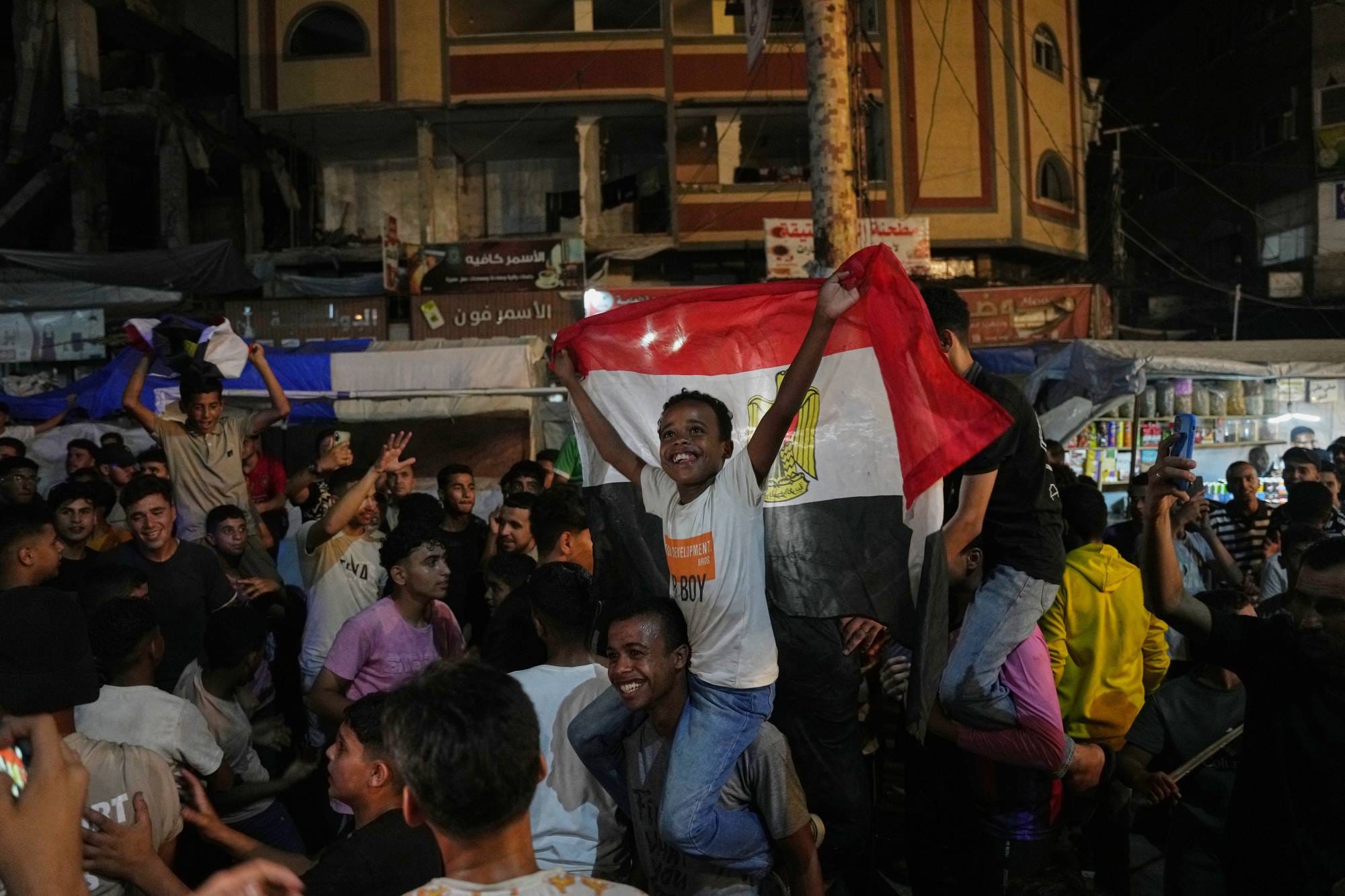
For one night in Gaza, the sounds of war were drowned out by cheers and unadulterated joy.
As Egypt defeated Australia in a penalty shootout on Friday, July 3rd to continue its historic World Cup run to the Round of 16, Palestinians from across the Gaza Strip—from the ruins of Gaza city to the makeshift tents in Deir al-Balah—took to the streets to celebrate.
“For 90 minutes, we forgot the bombs, we forgot the hunger, we forgot the displacement, we forgot everything,” said Ahmed al-Masri, who watched the match from the Shati refugee camp. “Egypt is not just a neighbour; Egypt is our brother, our shield, our hope. When they win, we win. When they cry, we cry.”
The Egyptian Committee for the Reconstruction of Gaza is among the humanitarian entities that has organized public watch parties for displaced Palestinians fleeing ethnic cleansing to watch the 2026 World Cup. The committee provided screens, seating and electricity in places like Gaza city to allow a rare moment of distraction from ongoing devastation. Children draped themselves in Egyptian flags while others gathered in crowds to cheer on the Egyptian squad, and its beloved talisman Mohamed Salah.
“I haven’t seen my children smile like this since before the war,” said Umm Khaled, a displaced woman from northern Gaza. “When Egypt scored, my youngest daughter jumped up and hugged me so tight. For a moment, she was just a child again, not a survivor. That is what Egypt gave us tonight.”
Beyond Palestine, Egypt’s unexpected World Cup run appears to be resonating far beyond football, offering millions across the Arab world a rare moment of shared pride and regional solidarity.
In Libya, fireworks were set off in the Libyan capital, Tripoli, as well as the city of Benghazi following Egypt’s 4-2 victory on penalties against Australia. Hundreds gathered in Martyr’s Square, where they sang Egyptian songs and waved the country’s flag. In Kuwait, public squares and shopping centres that had set up large screens to broadcast the match attracted large crowds of Kuwaiti citizens and members of the Egyptian community.
In Lebanon, celebrations spilled into the streets, with the country embracing the country and raising both the Lebanese and Egyptian flags as they danced and partied in various cities across the country.
Meanwhile, outgoing Arab League Secretary-General Ahmed Aboul Gheit congratulated Egypt and Morocco on their achievements in the 2026 World Cup, adding that their performances on the world stage is a source of pride for all Arab nations. The sentiment was shared by other Arab leaders, including UAE Vice-President, Prime Minister, and Ruler of Dubai Sheikh Mohammed bin Rashid Al Maktoum, who congratulated Egypt on its historic run.
“The Arabs’ joy today is Egyptian,” he wrote on his official X account.
When Morocco became the first Arab and African nation to reach the semi-final of the World Cup in 2022, the country enjoyed unrivalled support as the entire region rallied behind its national team. Egypt is now enjoying a similar reception as it continues to make history at the World Cup.
Despite participating as far back as the 1934 edition, Egypt—the country celebrated for winning a record seven African titles—had never managed to win a World Cup match until June 2026, when it defeated New Zealand 3-1 in Vancouver, Canada. The team then qualified for the knockout stage of the tournament without losing a single match, and went on to defeat Australia via penalties to set up a Tuesday showdown against Argentina.
Egypt is also one of two African and Arab teams left in the 2026 edition, alongside Morocco. Six other Arab teams have been eliminated from the competition, including five teams who failed to make it out of the group stage. Algeria was eliminated by Switzerland in the Round of 32.
African teams fared slightly better than their Arab counterparts. Nine of ten African nations made it out of the group stage, which is more than any other confederation at the tournament. However, only Egypt and Morocco managed to advance to the Round of 16 following disappointing results for Senegal and Cote d’ivoire.
As one of the few non-European or South American teams remaining in the competition, Egypt is carrying the hope and dreams of a wide range of peoples. This was evidently clear when Egypt’s coach, the legendary former striker Hossam Hassan, raised the Palestinian flag at Dallas Stadium following Egypt’s win against Australia.
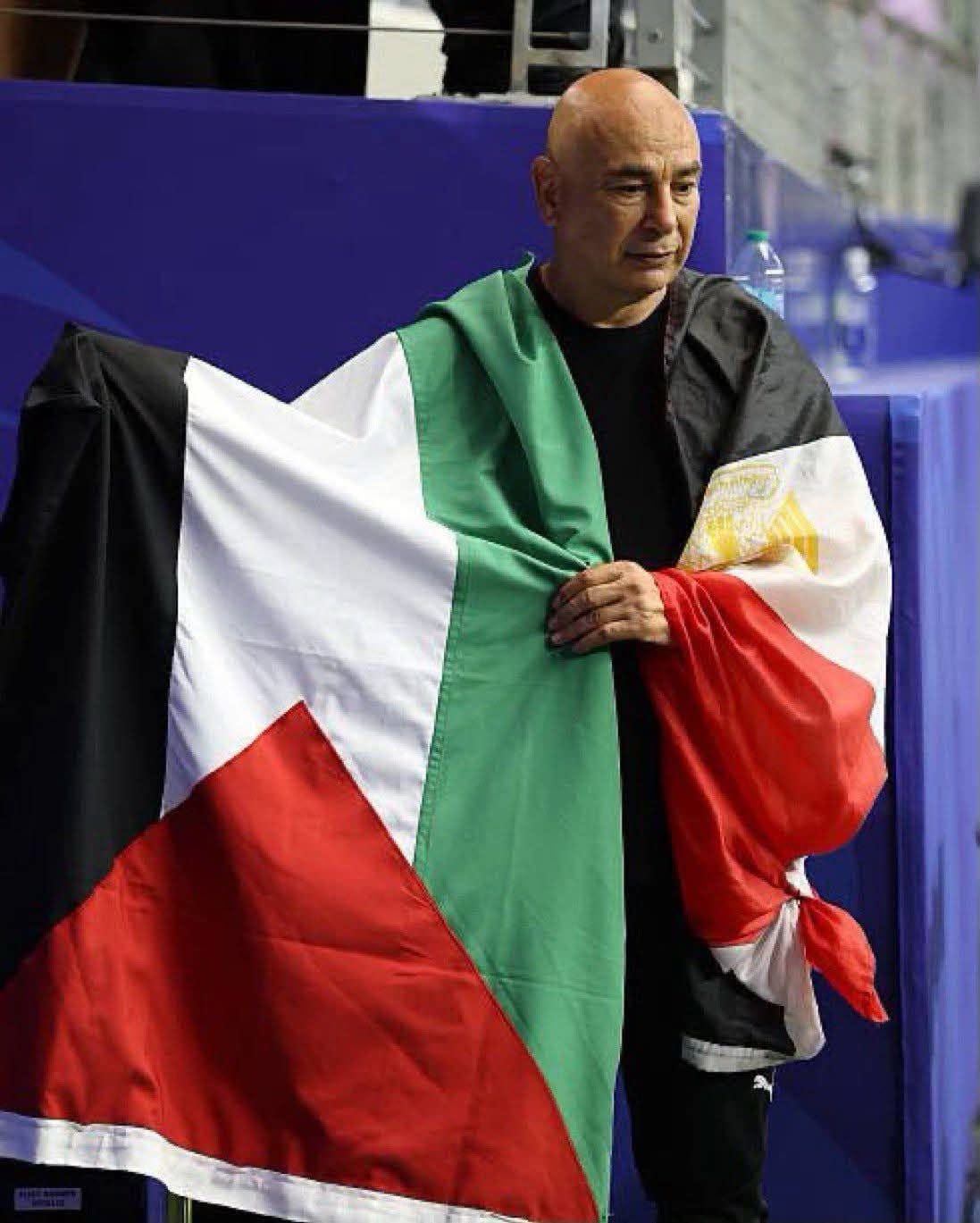
“May God grant them [the Palestinians] victory, may God have mercy on their martyrs,” Hassan told reporters following the game. “I’m saying to them: I’m dedicating this victory to the Egyptian people and Palestinian people, those kind and honourable people.”
Hassan’s gesture of solidarity was met with criticism from pro-Israel supporters, many of whom labeled the coach and the Egyptian team as “hypocrites.” Their argument rested on the ridiculous notion that Egyptians have no right to express support for Palestine because their government has closed the Rafah crossing between Egypt and Gaza and has maintained a strict blockade since October 7, 2023.
“Egypt built a fortified border wall to protect its citizens from Hassan’s “kind and honorable” Palestinian “martyrs,” whom most Arab governments view as a domestic threat and economic burden,” wrote one commentator on the Middle East Forum.
While the argument is a transparent attempt to undermine Arab solidarity with Palestine by conflating ordinary Egyptians with their authoritarian state, it also betrays the discomfort many of Palestine’s critics feel when confronted with expressions of solidarity that have endured despite war, repression and political division.
In the end, it is unlikely to change how the people of Gaza see Egyptians, or the bonds many still feel with them.
“Egypt reminded us that we are not alone. The Arab world has not forgotten us,” a young man from Khan Yunis told Egyptian media after the Australia match on Friday. “When Hossam Hassan raised that flag, he raised the hopes of every Palestinian in Gaza.”
Sports Politika is a media platform dedicated to the intersection of sports, power and politics. If you like what you see, upgrade to a paid subscription (or gift a subscription if you already have your own). We would appreciate if you could also like the post and let us know what you think in the comment section below.
Thank you for writing this 🇵🇸