

For One Night, Egypt Had Something to Celebrate
After 92 years, Egypt secured its first World Cup win in Vancouver on Sunday night. It is a historic moment for a nation that has had very few reasons to celebrate since the Egyptian revolution.

Welcome to Sports Politika, a media venture founded by award-winning investigative journalist Karim Zidan that strives to help you understand how sports and politics shape the world around us. My mission is to offer an independent platform for accessible journalism that raises awareness and empowers understanding.
If you share this vision, please consider supporting my work by joining becoming a paid subscriber or by pre-ordering my new book, THE ULTIMATE STRONGMEN.
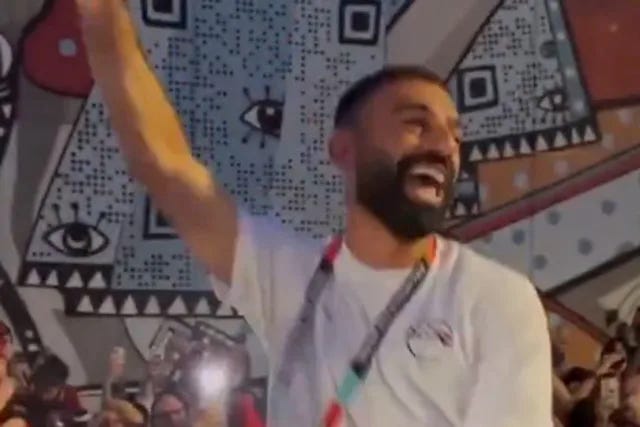
Hours after helping mastermind Egypt’s 3-1 comeback victory against New Zealand to secure his nation its first ever World Cup victory, Mohamed Salah felt like celebrating.
As the team’s bus arrived at its downtown Vancouver hotel, the players plunged into the crowd gathered outside, standard protocol be damned. One carried a JBL party speaker blasting Egyptian mahraganat music. Another hoisted Salah onto his shoulders as chants rang out from the ecstatic supporters surrounding them.
The celebrations spilled across downtown Vancouver and lasted deep into the night. And as dawn broke nearly 11,000 kilometres away in Cairo, millions more joined the party.
Egypt’s 3-1 victory against New Zealand, which took place in front of more than 52,000 (mostly Egyptian) attendees at BC Place in Vancouver, Canada, ended Egypt’s 92-year drought at the quadrennial tournament. Since debuting at the 1934 World Cup in fascist Italy, Egypt had failed to win a single match, despite earning hard fought draws with The Netherlands and Ireland in 1990, back when Hossam Hassan was Egypt’s star player rather than its coach. In a remarkable change of fortunes, Egypt now sits at the top of Group G with four points after holding Belgium to a 1-1 draw and defeating New Zealand on Sunday.
“My feelings are exactly the same as those of the Egyptian people because I am one of them,” Hassan reflected afterwards. “I told the players at half-time, ‘We are playing in Egypt.’ The stadium was so full, it truly felt like Cairo.”
As thousands of Egyptians took over the streets of Cairo on Monday morning, chanting, singing and waving flags with smiles of joy etched across their faces, it was a reminder that the nation of more than 100 million had very few opportunities to celebrate.
Over the past few years, Egypt has endured the most severe economic crisis since the 2011 revolution. The current debt crisis, spurned government spending on mega projects, has resulted in soaring inflation, capital flight, and a weak currency that continues to fall against the dollar. This constellation of economic disasters has rendered the cost of living unaffordable for the average Egyptian.
Egypt’s economic outlook has started to improve over the past year. The country’s GDP is increasing while its credit rating was recently upgraded. Nevertheless, Egypt continues to rely on investments from the Gulf, such as the developments being undertaken by Qatar and the UAE along Egypt’s mediterranean coast, while inflation and a rising cost of living continues to plague Egyptians.
Egyptians under the poverty line and struggling to find cheap food amid soaring prices. More than 70% of Egypt 105 million population relies on the government’s bread subsidy programme, making it the largest food subsidy program in the Middle East and North Africa. With little else to offer hope and joy, Egyptians have historically turned to football for their fleeting moments of joy.
Despite its weak World Cup resume, Egypt has a storied footballing history. In 1957, the inaugural Africa Cup of Nations (AFCON) was held in Khartoum, Sudan. There was no qualification process; the tournament field consisted solely of the four founding members of the Confederation of African Football (CAF): Egypt, Sudan, Ethiopia, and South Africa. South Africa was disqualified after insisting on selecting an all-white squad in accordance with its apartheid policy, a decision that granted Ethiopia a bye directly to the final. As a result, only two matches were played. Egypt was crowned the first continental champion after defeating host nation Sudan 2–1 in the semi-final and Ethiopia 4–0 in the final.
Egypt’s victory carried far more than mere national pride. The country had just emerged from the Suez Canal Crisis, during which British and French forces—acting in concert with Israel—invaded Egypt in an attempt to protect their interests in the recently nationalized canal. The ensuing international backlash forced a humiliating withdrawal, dealing Britain a severe blow to its legitimacy and global standing and marking one of the final nails in the coffin of its imperial ambitions. The fact that Egypt—newly free and independent—had won the inaugural competition so closely associated with decolonization became a powerful symbol for a burgeoning African continent.
Egypt has since continued to make AFCON history. The Arab world’s most populous country has won the event a record seven times, including three consecutive wins in 2006, 2008, and 2010.
However, the country has not managed to reclaim its former glory since the 2011 Arab Spring, which was the same year that Salah first appeared on the national team. Since then, Egypt has reached the finals on two occasions (2017 and 2021). In the 2021 edition of AFCON, Salah’s team came close to winning the cup but fell short in a penalty shootout against Sadio Mané’s Senegal.
Despite the loss, it had been Egypt’s best performance in years. In 2018, Egypt crashed out of the World Cup without winning a single match. The following year, Egypt hosted AFCON but failed to reach the quarter-final stage in a tournament plagued with scandals including accusations of sexual harassment against Salah’s teammate Amr Warda.
After failing to qualify for the 2022 World Cup in Qatar, Egypt reached the semi-final at the 2025 AFCON in Morocco, where they were once again defeated by Senegal. Since then, the team has maintained an excellent record in World Cup qualification and is now on track to reach the knockout stage of the tournament for the first time in its history.
And though Egyptians deserve to celebrate and bask in this rare moment of unbridled joy, the Egyptian state is never far behind.
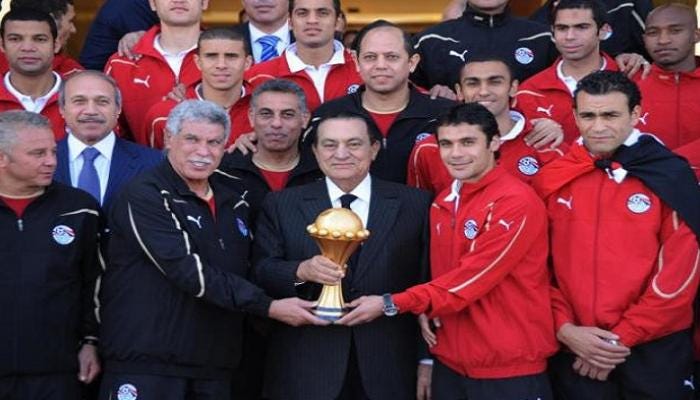
A few months before the 2006 Africa Cup of Nations, President Hosni Mubarak secured another six-year term in elections widely criticized for human rights abuses and electoral interference. Despite the regime’s growing unpopularity, Mubarak and his family became fixtures at Egypt’s matches, cultivating a symbolic association between the government and the national team’s success.
The contrast became even starker in February 2006, when the MS al-Salam Boccaccio 98 ferry sank in the Red Sea on its return voyage from Saudi Arabia, killing more than 1,000 Egyptian workers and pilgrims. Mubarak allowed Mamdouh Ismail, the ferry’s owner and a businessman with close ties to the regime, to leave for London without facing trial. While he never visited the victims’ families, Mubarak found time to host Egypt’s victorious footballers at the presidential palace, lavishing attention on figures admired by millions across the country.
By 2011, Egypt’s Ultras groups, the hardcore football fans who supported Egypt’s leading clubs, became instrumental figures in the 18-day uprising in January. Emerging as revolutionaries, these football fans helped topple Mubarak’s regime and emerged as a potent political force in post-revolution Egypt. Within a year, the group would face one of the worst tragedies in football history.
On February 1, 2012, riots occurred following an Egyptian Premier League match between Al Ahly and Al Masry in Port Said. 74 people were killed that day, including 72 Ultras supporters. 500 Egyptian citizens were wounded in the assault. Some were beaten to death with clubs and sticks; some were stabbed; others were trampled. Most of the deaths were due to police inaction. Officials refused to open the stadium gates, trapping fans inside and causing a stampede. In response to the tragedy, the Egyptian government shuttered the Egyptian league for two years, which had a miserable effect on the national team.
In the 14 years since the Port Said massacre, much has changed in Egypt. In 2013, a coup d’état saw Egypt’s military oust Mohamed Morsi, a member of the Muslim Brotherhood and Egypt’s first freely elected president, paving the way for Abdel-Fattah el-Sisi to ascend to the presidency. Egypt has since faced an unprecedented wave of human rights abuses and oppression. Even football—Egypt’s national sport and pastime—was not sparred.
Which is what makes the team’s success in Vancouver so remarkable. Against the backdrop of economic collapse, political oppression, a hollowed-out domestic league and years of footballing frustration, Egypt found something it had been denied for far too long: joy.
Sports Politika is a media platform dedicated to the intersection of sports, power and politics. If you like what you see, upgrade to a paid subscription (or gift a subscription if you already have your own). We would appreciate if you could also like the post and let us know what you think in the comment section below.